



Manufacturing costing software works out what one unit really cost: material from the bill of materials, labour, machine time and overhead, less scrap sold, divided by good units. It is worth buying only if it records those inputs as work happens. This guide shows one cost sheet in rupees and a checklist for Indian factories.
Most pages on this topic list features. They rarely show a cost sheet with wastage, or why the standard and actual figures drift apart. Below is a worked example, the rules that apply in India, and ten things to check before you trust any system. If you still cost in Excel or Tally, our Tally vs ERP guide shows where that starts to break.
What does manufacturing costing software have to do?
It must turn plant events into a cost per unit without anyone retyping them. That means five jobs.
- Hold the bill of materials (BOM) with allowed scrap on each line, and keep versions.
- Issue material to a batch at its real purchase price, including freight.
- Record hours on labour and on machines, by batch.
- Record scrap and by-products with a reason and a weight.
- Post the result to stock and to accounts, so the cost sheet and the ledger agree.
If a system cannot do job 4, the cost per unit will look neat and be wrong. Scrap is where most of the gap hides.
How is cost per unit worked out? A cost sheet with scrap
Cost per unit is the total cost of a batch, less scrap sold, divided by good units. The figures below are illustrative. They are not from a customer. The inputs are realistic for a small pressing line.
Take a batch of 1,000 pipe clamps. The standard is what the batch should cost. The actual is what it cost.
| Cost line | Standard (₹) | Actual (₹) |
|---|---|---|
| Steel strip: 840 kg at ₹62 standard; 900 kg at ₹66 actual | 52,080 | 59,400 |
| Fasteners: 2,000 at ₹3 | 6,000 | 6,000 |
| Packing | 2,000 | 2,000 |
| Labour: 100 hours at ₹240 standard; 118 hours actual | 24,000 | 28,320 |
| Machine and overhead: ₹180 per hour, 100 hours standard; 118 actual | 18,000 | 21,240 |
| Less scrap sold: 40 kg at ₹30 standard; 100 kg actual | (1,200) | (3,000) |
| Batch cost | 100,880 | 113,960 |
| Cost per clamp | ₹100.88 | ₹113.96 |
The standard steel of 840 kg is 800 kg in the clamps plus 40 kg of allowed offcut. The actual batch used 900 kg. The clamps were sold on a ₹115 quote based on the standard. At standard cost, the margin is ₹14.12, or 12.3%. At actual cost, it is ₹1.04, or 0.9%. Nobody saw it until the month ended.
Why do standard cost and actual cost drift apart?
They drift because price, usage and time each move on their own. A system should split the gap by cause. The method is the one taught in the ICAI standard costing material: compare actual with standard, then explain each variance.
For material, two formulas do most of the work.
- Price variance = (standard price − actual price) × actual quantity.
- Usage variance = (standard quantity − actual quantity) × standard price.
In the example, steel cost ₹4 per kg more than standard (₹66 against ₹62). On 900 kg, that is ₹3,600 adverse. The batch used 60 kg more than the 840 kg allowed. At ₹62, that is ₹3,720 adverse. Add them and you get ₹7,320, which is the full steel gap (₹59,400 less ₹52,080).
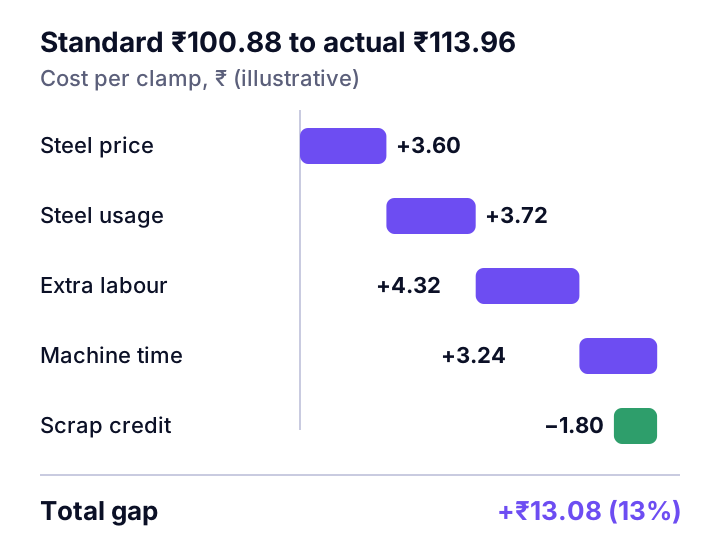
The remaining gap came from 18 extra hours. Each hour cost ₹240 in labour and ₹180 in machine and overhead. That is ₹4,320 and ₹3,240, or ₹7,560 together. The extra scrap sale gave back ₹1,800. So the total is 7,320 + 7,560 − 1,800 = ₹13,080 adverse, or ₹13.08 per clamp.
The scrap credit hides the loss
Look at the 60 kg of extra scrap. It cost ₹62 per kg to buy and sold for ₹30. The net loss is ₹32 per kg, or ₹1,920. A report that shows only the total scrap credit makes the batch look better than it was. Ask any system to show scrap as a quantity and a reason, not just as a sale value.
Which costing rules apply in India?
India has no law that forces standard costing. But the way you value stock is set by accounting standards, and costing software must follow them. Companies that follow Ind AS use Ind AS 2 on inventories. This is a copy of the standard's text. Check the numbering against the official ICAI or MCA version before you quote it to an auditor.
| Rule in Ind AS 2 | What it means for your cost sheet |
|---|---|
| Purchase cost excludes taxes the entity can later recover (para 11) | Input GST you can claim is not part of material cost. Freight and handling are. |
| Fixed overhead is spread on normal capacity (para 13) | Do not raise the cost per unit because the plant ran half empty. Expense the unabsorbed part. |
| By-products may be valued at net realisable value and deducted from the main product (para 14) | A by-product credit is allowed, but it needs a weight and a price. |
| Abnormal waste is expensed, not added to stock (para 16) | Set an allowed scrap rate. Treat the excess as a period loss. |
Companies that do not follow Ind AS use AS 2, which has the same ideas. Your auditor decides which applies.
What should you check before you buy?
Test the system with one real BOM from your plant, not the vendor's demo. Use this list.
- Can the BOM have several levels, and does it keep old versions?
- Can you set an allowed scrap rate per line, and does the system flag the excess?
- Does each material issue use the real purchase price, with freight added?
- Can it handle a main product and a by-product from one run?
- Does it record machine hours as well as labour hours?
- Can job work out and in carry cost, and not just quantity?
- Does the cost sheet show variance split into price, usage and time?
- Does work in progress carry cost between shifts and stages?
- Does the finished cost post to stock and to the ledger without retyping?
- Is every cost entry logged with who made it and when?
On point 10, Indian companies must use accounting software with an audit trail that cannot be switched off. The ICAI Journal explains the requirement. Side sheets kept in Excel have no such log.
Where does costing software go wrong?
It goes wrong when the inputs are late or guessed. A good cost engine fed with bad data gives a precise wrong answer.
- Hours entered at month end. If operators note hours on paper, the cost is a guess. Capture hours at the machine, or at least at shift end.
- One average price for steel. A rise in price shows up as a usage problem. Issue material at batch price or by a clear weighted average rule.
- Scrap lumped into "other". Without reasons, you cannot fix the cause.
- Standards that never change. If the standard price is two years old, every batch looks adverse. Review standards at least once a year.
- Overhead spread on a guess. Use a rate per machine hour. Check it against normal capacity.
Costing also fails when the BOM is wrong. In the ICAI-style method, every variance assumes the standard is right. If the BOM omits packing or allowed scrap, the sheet will blame the shop floor for a master data error. Fix the BOM first. Our ERP implementation checklist covers master data clean-up.
How does an ERP help with costing?
An ERP helps when the plant events that feed cost are recorded once, at the source. Then the cost sheet is a by-product of normal work. See our guide to manufacturing ERP for the full module map, and the ERP cost guide for what a system costs.
ZapNexa ERP, our manufacturing ERP, ties a production order to its bill of materials. It reserves the material, consumes it on the shop floor and books scrap with a reason. The production cost (material, labour, machine and overhead) posts to accounting, as described on the ZapNexa page. Check each point in the list above against a demo with your own BOM. Do not take any vendor's word for it, ours included.
What to do this week
Pick your best-selling item. Write its BOM with allowed scrap. List the actual material, hours and scrap for the last three batches. Work out the cost per unit for each. If the three numbers differ by more than a few percent, you have a costing problem worth fixing, and you now know which line to look at first. For the business case, the CFO guide to ERP ROI shows how to put a rupee figure on it.
Frequently asked questions
How do you calculate cost per unit in manufacturing?
Add the material, labour and overhead spent on a batch, subtract any scrap or by-product sale value, and divide by the good units made. Material comes from the bill of materials plus the allowed scrap. Labour and machine cost come from hours used. Count only good units in the divisor, because rejected units still carried cost.
What is the difference between standard cost and actual cost?
Standard cost is what a unit should cost, set in advance from the bill of materials, allowed scrap, expected hours and current prices. Actual cost is what the batch really cost. The gap between them is the variance. A good costing system splits that gap by cause, such as price, usage and hours, so you know what to fix.
Can Tally do manufacturing costing?
Yes, at a basic level. TallyPrime has bills of materials and a Manufacturing Journal that works out cost per unit from the components. It is enough for simple products. It gets hard when you have many BOM levels, scrap by reason, machine hours or several plants. Then most firms keep Tally for accounts and add production costing elsewhere.
Is scrap part of the cost of a unit?
Normal, expected scrap is part of cost. Abnormal waste is not. Ind AS 2 says abnormal amounts of wasted material, labour or other production cost are expensed in the period, not added to inventory. So set an allowed scrap rate per item. Treat what goes above it as a loss to investigate.
Test your cost-per-unit gap
Put in your users, plants and the hours your team spends fixing numbers by hand, and see what a manufacturing ERP would pay back.