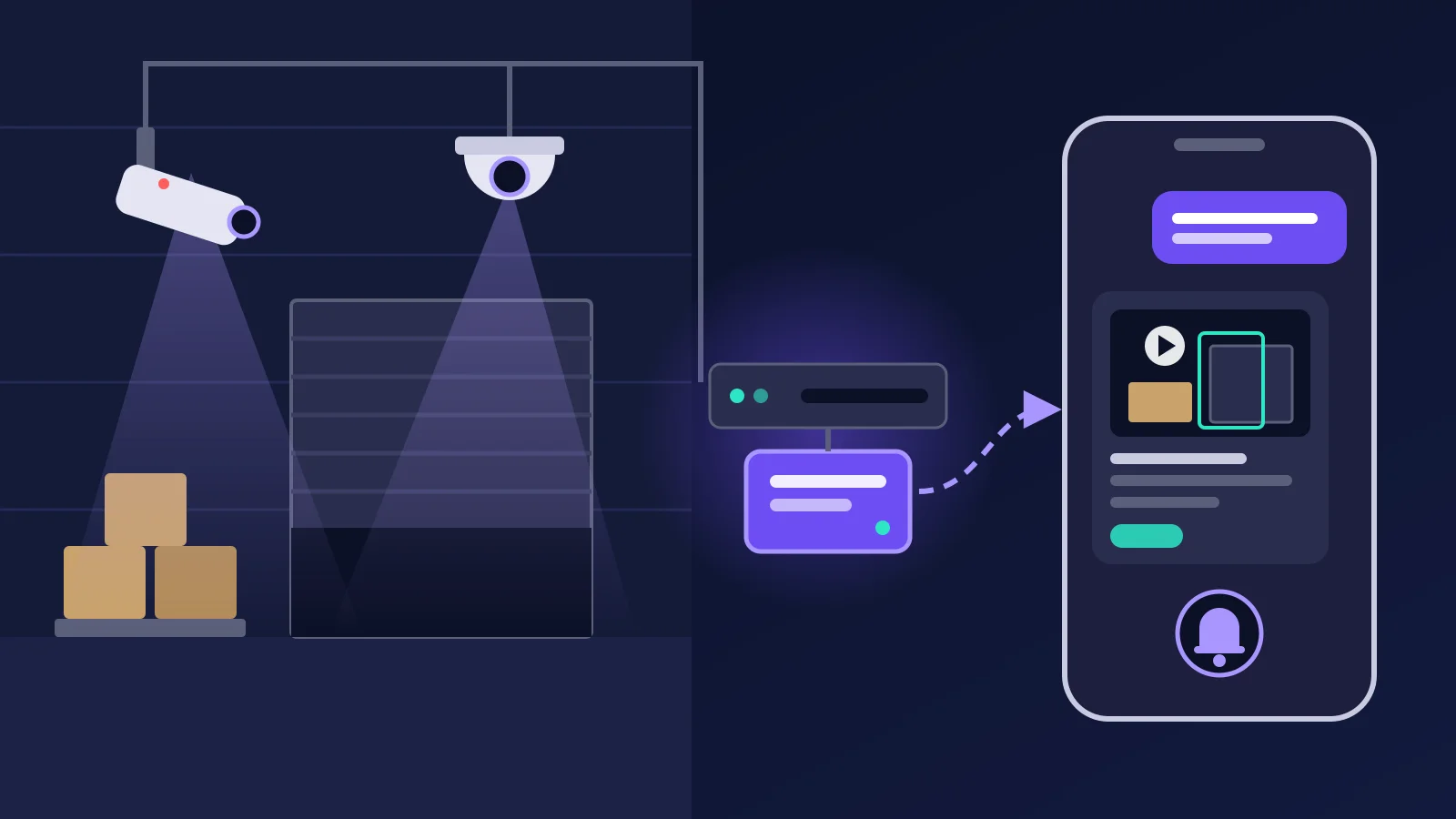



A PPE detection system for a factory can run on CCTV you already own if each camera shows the worker large and clearly. Hard hats and high-visibility vests work best. Gloves, goggles and ear protection need a close camera. A 2022 research paper found 99% accuracy at 3 metres and 89% at 5 metres.
Most vendor pages promise all of this from any camera. The real answer depends on pixels, angle and light at each spot. This guide gives a simple check you can run before you pay for anything. It covers which PPE a camera can see, how to test a rule on your own footage, why alerts get ignored, and what India's data law asks of you.
Which PPE can a normal CCTV camera check?
Big, bright items are easy. Small items are hard. Plan your first rules around what a camera can really see.
| PPE item | Camera difficulty | Our advice |
|---|---|---|
| Hard hat or helmet | Easy | Start here |
| High-visibility vest | Easy | Start here |
| Safety shoes | Hard | Skip, feet are often hidden or out of frame |
| Goggles or glasses | Hard | Close camera at a gate or machine entry only |
| Gloves | Hard | Close camera, front view, test carefully |
| Ear protection | Hard | Same as goggles |
The same split shows up in research. The paper above tried five classes (hard hats, vests, gloves, glasses and hearing protection) and reported that small size and body parts blocking the item both cut accuracy. The authors cropped to the worker's body before looking for PPE to help. A site camera does not do that for you.
One Indian vendor's guide to PPE monitoring on existing CCTV gives useful camera advice. It suggests mounting about 2.5 to 3.5 metres high, angled down 15 to 30 degrees, at a single-lane choke point, and it warns about backlight from open shutters. It gives no accuracy figure, so treat any such number you are quoted as unproven until you test.
How many pixels does a helmet need?
Count pixels on the item, not on the whole scene. Our rule of thumb is a helmet at least 40 pixels wide. Below that, a model is guessing.
Here is a worked example with our own arithmetic. We assume a hard hat is about 0.3 metres wide. A 1080p camera is 1,920 pixels wide.
| Camera covers | Pixels per metre | Helmet width on screen |
|---|---|---|
| 10 m wide aisle | 192 | About 58 pixels |
| 20 m wide bay | 96 | About 29 pixels |
| 30 m wide yard | 64 | About 19 pixels |
So the same camera can check helmets in a narrow aisle and fail across a yard. Our guide to adding AI to existing CCTV cameras explains the pixels per metre levels in IEC 62676-4 and how to check each camera's stream.
The fix is usually a better camera position, not a better model. Move one camera to the gate where everyone walks past in single file. A choke point gives a front view, a steady distance and few people hiding each other.
What camera angle and light does PPE detection need?
A front or slightly side view, at head height or a little above, with even light. These are the five problems we would check on a walk of the site.
- Too high. A camera on a 9 metre roof sees the tops of heads. A vest is hidden and a helmet looks like a dot.
- Backlight. A camera facing an open shutter at noon sees dark shapes.
- Night. Infrared footage is grey. A yellow vest and a white shirt can look the same. Pull a clip from 2 am before you plan a night shift rule.
- Crowds. In a busy aisle, one worker hides another.
- Dust and condensation. In monsoon, a fogged lens ruins every rule on that camera.
Take a phone and stand where the camera points. If you cannot tell by eye whether a worker wears a vest, the AI will struggle too.
How should you test it before going live?
Run the rule for one week with alerts off, then compare it with what a supervisor sees. This is the step most buyers skip.
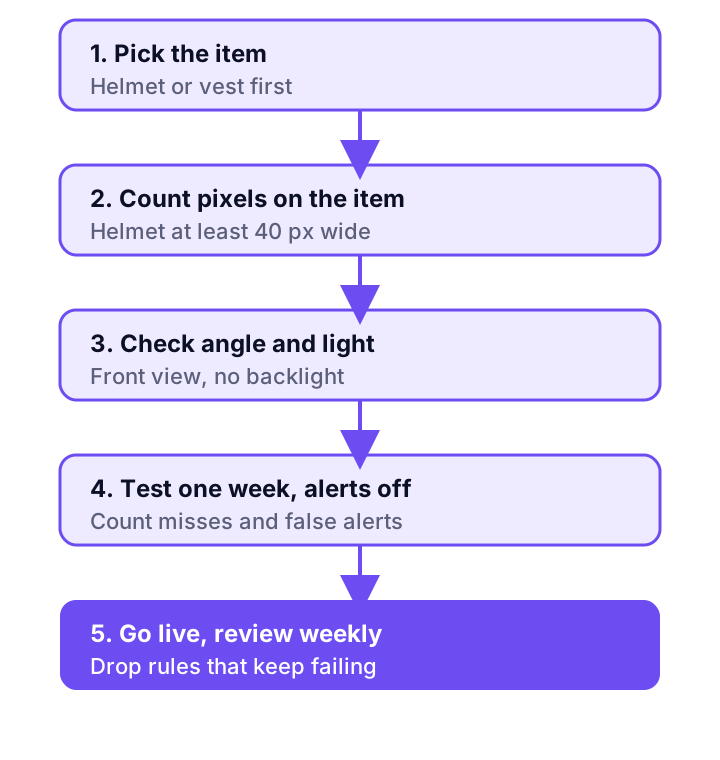
A simple test sheet for each camera:
- Violations seen by a person in the test week (a supervisor notes them).
- Violations the system caught. The gap is your miss rate.
- Alerts that were wrong. A worker with a helmet on a trolley, a reflective jacket on a hook. That is your false alert count.
- Time of day for each miss. Misses often cluster at shift change, when light is low.
Do not accept a vendor figure such as "95% accurate" without asking: on whose footage, at what distance, for which item? The research above shows the number can drop ten points when the worker steps back two metres.
Why do PPE alerts get ignored?
Because they come too often and prove too little. An alert that fires fifty times a night is muted by the second week. Fix this in the rule, not in the people.
- Zones. Draw only the area where the PPE is required. A visitor walking in the office corridor is not a violation.
- Persistence. Ask for the missing helmet to hold for several seconds. A worker who passes behind a pillar for one frame is not a violation.
- A second check. A slower model can look at the frames before the alert is sent.
- A clip with the alert. A supervisor decides in five seconds if they can see the clip.
- One owner. Name who gets the alert on each shift. An alert sent to a group chat belongs to nobody.
- Weekly review. Mark each alert true or false. Drop or fix the rules that keep failing.
For the wider false alarm toolkit, see the section on false alarms in our CCTV readiness check.
Where does PPE detection go wrong?
It can miss, it can accuse wrongly, and it can make a safety problem look solved. Keep these limits in view.
- It is not a safety system. A camera alert comes after the worker is already unprotected. Guarding, lockout and supervision still do the real work.
- It checks the item, not the fit. A helmet with an open strap counts as a helmet.
- It needs upkeep. A bumped camera points at the wall and its rules quietly stop working.
- Workers may change habits only near cameras. Cover the whole risk area, not just the gate.
- Trust needs a plan. Tell the workforce what is checked and why, before the first alert.
Plants that have already added sensors to old machines know the pattern. Our post on retrofitting IoT sensors on old machines makes the same case: use what is installed, add only what is missing, and test before you trust. The same thinking applies in heavy industry such as integrated steel plants, where dust, glare and heat make camera checks harder.
What does India's DPDP law mean for PPE cameras?
Footage of workers who can be identified is personal data in digital form, so the Digital Personal Data Protection Act, 2023 is likely to apply. This is a summary, not legal advice. Ask your lawyer about your own case.
- Employment purposes. Section 7 of the Act lets an employer process data for employment purposes. The full text should be read by your lawyer before you rely on it.
- Timeline. The DPDP Rules, 2025 were notified in November 2025. Most duties apply 18 months after that, which is about mid-May 2027.
- Plain steps. Tell workers about the cameras with a notice, write down why each camera exists, keep clips only as long as needed, limit who can view them, and leave face recognition off. A PPE rule does not need to know who the worker is.
Where Camryx fits
Camryx is our AI for the CCTV you already have, now in early access. It lets you write alert rules in plain words, such as no helmet in the work area. A vision model checks each alert before it reaches your phone, WhatsApp or Telegram. Recordings stay on your recorder, and there is no face recognition. We make no accuracy claim for early access, so run the one week test above on your own cameras. See Camryx.
Frequently asked questions
Can a normal CCTV camera detect helmets and safety vests?
Often, yes. Hard hats and high-visibility vests are large and have strong colour, so a camera that shows a worker at least 40 pixels across the head can usually check them. Test it on your own footage first. Backlight, a high mounting angle and night infrared are the usual reasons it fails.
Can AI check gloves, goggles and ear protection?
Less reliably. These items are small, and hands and tools often hide them. One research paper that tried five PPE types found accuracy fell from 99% at 3 metres to 89% at 5 metres. For gloves and goggles, plan a closer camera at a choke point such as a gate or machine entry.
Do I need face recognition for PPE detection?
No. The rule only needs to know that a person is in an area and whether a helmet or vest is on them. Naming the person is a separate, more sensitive step. Leaving it out means less personal data to protect under India's DPDP Act.
How many false alerts should I expect?
We found no independent false alert rate for Indian plants, so we do not quote one. Run the rule for a week with alerts switched off. Count missed violations and false alerts against what a supervisor sees. Go live only when the false alerts are low enough that people still read them.
Test PPE rules on the cameras you already have
Camryx reads the CCTV, DVR or NVR you already own and checks alert rules written in plain words. Now in early access.