

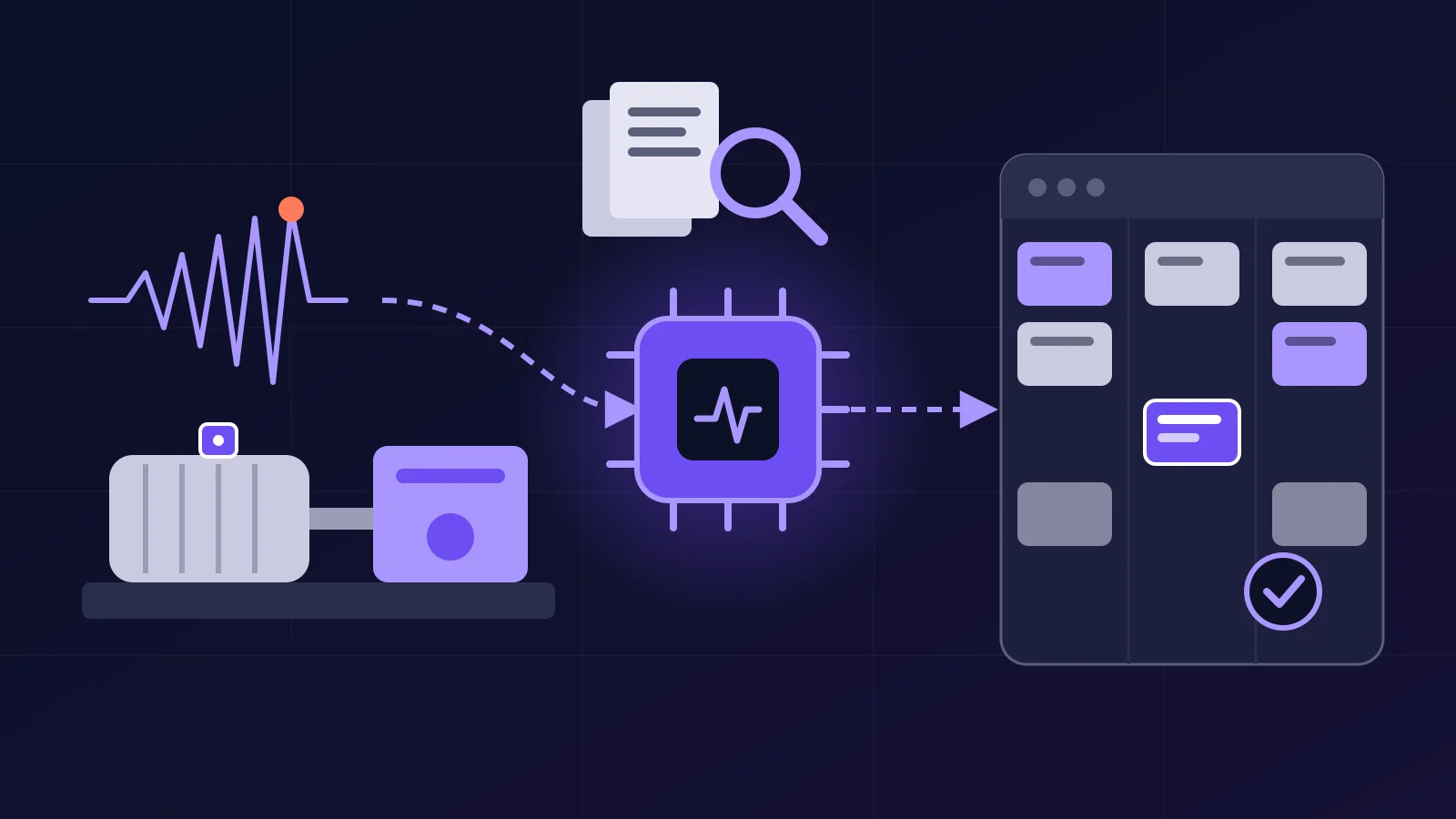
AI for maintenance planning works well today in two places: spotting a developing fault in vibration and temperature data, and finding the right step in an OEM manual with its source. It helps a planner draft schedules and code work orders. Of the five planning steps, the planner still owns the hard parts of three: shutdown windows, permits and root cause.
Vendor pages say AI will plan maintenance on its own. In a steel, cement or power plant that is not true yet, and a maintenance head who expects it will be let down. This post splits the planning cycle task by task. It says which tasks AI does reliably, which it only helps with, and which stay with a person. It ends with a data checklist, because most AI projects in maintenance fail on data, not on the model.
What does AI for maintenance planning mean in a heavy plant?
It means three different tools doing three different jobs. Mixing them up is the first mistake buyers make.
| Kind of AI | What it reads | What it does in planning |
|---|---|---|
| Machine learning on sensor data | Vibration, temperature, motor current | Finds a fault early, so a breakdown becomes a planned job |
| Language models on documents | Manuals, SOPs, work order history | Finds steps, specs and past fixes; codes free text |
| Scheduling tools | Backlog, crew hours, priorities | Drafts a weekly schedule for the planner to edit |
The planning cycle itself has five steps: identify the work, plan it, schedule it, execute it and close it out. Each kind of AI fits a different step. Our pillar on the engineering assistant LLM covers the document side in more depth.
Which planning tasks can AI do reliably today?
Two tasks: finding faults early from condition data, and finding answers in your own documents with a citation. Both are narrow, and both are checkable by an engineer.
Finding faults before they become breakdowns
A model that learns how a fan or gearbox normally runs can flag bearing wear, misalignment or imbalance days to weeks before failure. This is the oldest and best-proven use. The US DOE O&M Best Practices Guide (Release 3.0, 2010) put the savings of a predictive programme at 8% to 12% over preventive maintenance alone. It said plants that rely mostly on breakdown repair could save 30% to 40%. The data is old and from the US, but the direction still holds.
For planning, the value is time. An early warning on an imported gearbox bearing gives stores weeks to order it. It lets the planner fit the job into the next planned stop instead of an emergency one. Our vibration analysis basics explain what the model is reading.
Finding the right step in the manual
A language model that searches your manuals and SOPs can answer "what is the coupling bolt torque on pump P-104?" in seconds. It must show the page it used. A 2025 PHM Society paper tested this on ground vehicle manuals. Retrieval methods did better than pure language model methods at matching fault codes. The chat-style task struggled to link what a technician saw to the right fault code. The lesson for a plant: trust answers that quote the manual, and check them.
Where does AI help, but the planner still decides?
AI is useful in four more tasks, as long as a person reviews every output. In each, the AI does the searching and the planner makes the call.
- Drafting the weekly schedule. A tool can sort the backlog by priority and fit jobs to crew hours. It cannot see that production moved the mill stop by a day.
- Estimating parts and hours. Finding similar past jobs gives a fair first estimate. It is only as good as the history behind it.
- Coding work orders. Turning "brg noisy, chngd, ok" into a failure mode and cause is hard. NIST researchers found that maintenance text is full of jargon and shorthand. General language tools often fail on it (Brundage and others, 2021). NIST's own Nestor tool keeps a person in the loop to tag the text.
- Spares lookahead. Matching planned jobs against stock and lead times flags shortages early. The buyer still has to chase the supplier.
What still needs a human planner?
The tasks that depend on the whole plant, on safety, or on people outside maintenance. These are also where most of a planner's real skill sits.
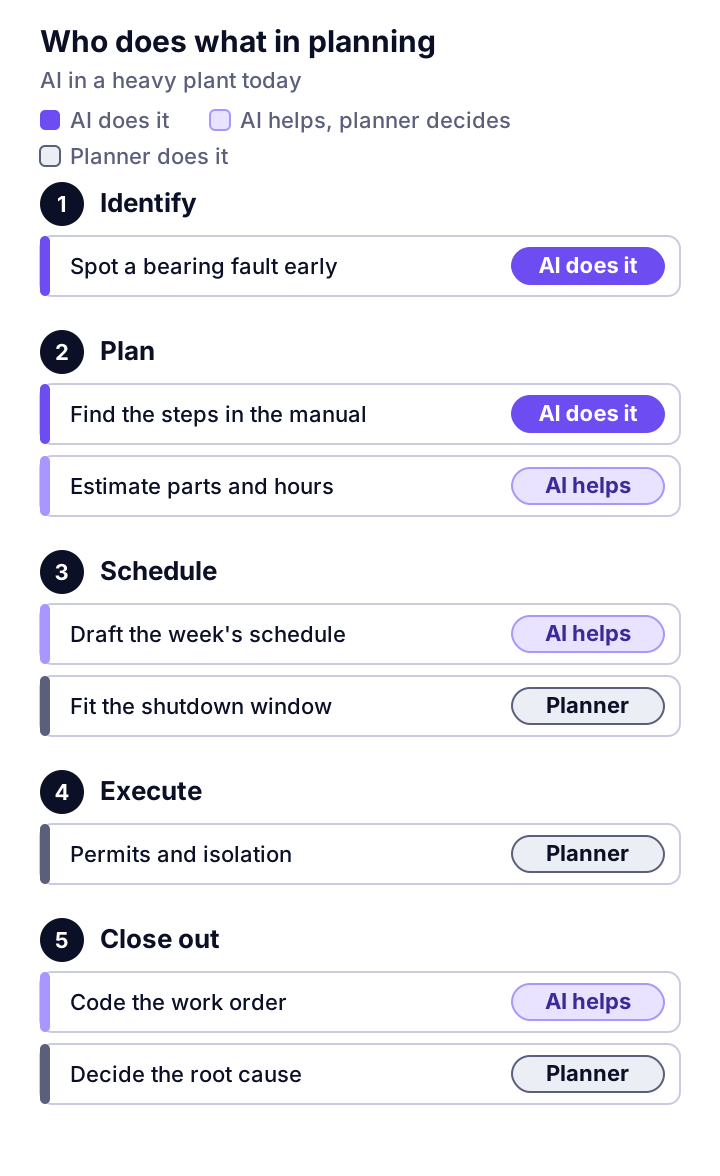
- Fitting work into shutdown windows. A kiln stop, a blast furnace reline or a power unit overhaul fixes the calendar. Deciding which jobs go into a 72-hour stop, and in what order, takes plant knowledge no tool has.
- Permits and isolation. Lockout, hot work and confined space permits are safety-critical. A person signs them, and a person checks the isolation.
- Agreeing stoppages with production. In a three-shift plant there is little time when a machine is free. Getting a four-hour window on a running mill is a conversation, not a calculation.
- Contractors, cranes and scaffolding. Their availability lives in phone calls and emails, not in any system.
- Weather. In the monsoon, outdoor work on stacks, conveyors and cooling towers moves around the rain.
- Root cause. AI can suggest likely causes. Deciding why the third gearbox failed in a year is engineering judgement.
Is your data ready? A checklist before you buy
Check these six things first. If three or more are missing, fix the data before you buy a scheduling tool. Fault detection on live sensor data can still start in parallel, because it needs less history.
- Asset register. Every machine has one unique tag, placed in a hierarchy: plant, line, asset, component.
- Coded work orders. Closed jobs record failure mode, cause and action in coded fields, not just free text. ISO 14224 was written for oil and gas, but its failure mode lists are a good starting point for any heavy plant.
- Condition data on critical assets. Vibration and temperature on the machines whose stop stops the line, with a few weeks of normal running as a baseline.
- Current manuals and SOPs. The latest revision, as searchable files, not photos of photocopies.
- Spares master. Each critical spare has a lead time and a criticality rank.
- Crew skills. Who can do alignment, who holds which permit, who is on which shift.
Where does this go wrong?
AI planning projects fail in the same few ways. Most of them are not about the model.
- False alarms. A fault model that alerts too often gets ignored within a month. Start with a few critical machines and tune the alert levels. Our post on why predictive maintenance pilots fail covers this.
- Answers without sources. A chatbot that gives a torque value with no page reference is a safety risk. Reject any tool that cannot show its source.
- Bad history in, bad schedule out. A scheduler trained on work orders that say "done" teaches nothing.
- Alerts that go nowhere. An early warning helps only if it becomes a work order. Our guide to linking condition monitoring with the ERP shows that hand-off.
- Buying autonomy. If a vendor says the tool plans on its own, ask who signs the permit.
How do VMI-1 and EVA-1 fit?
They cover the two tasks AI does reliably. Neither builds your schedule; the planner does. VMI-1 learns each machine's normal vibration, temperature and power signature. It flags bearing wear, misalignment, imbalance and looseness, and points to the frequency band behind each alert. It runs inside Vexron predictive maintenance, whose alert rules can raise an entry in SAP S/4HANA or your MES. EVA-1 answers from your own manuals, SOPs and maintenance records, and cites the document and section. To see what an avoided breakdown is worth first, use the downtime cost calculator.
Frequently asked questions
Will AI replace the maintenance planner?
No. Today AI takes over some of the searching and sorting a planner does: it spots developing faults in sensor data, finds steps in manuals and drafts a first schedule. The planner still fits jobs into shutdown windows, sequences permits and isolation, agrees stoppages with production and owns safety. Expect a planner who spends less time looking things up, not a plant without a planner.
Can AI make a maintenance schedule on its own?
It can draft one. Scheduling tools can sort the backlog by priority and fit jobs to crew hours. They do not know that the kiln stop moved by two days, that the crane is booked, or that the bearing is still at the port. Treat the AI schedule as a first draft that the planner edits and approves.
How clean does our CMMS data need to be before AI helps?
Clean enough that each asset has one tag and each closed work order says what failed, why and what was done, in coded fields. Free text alone is hard for any tool to learn from. Fault detection on live sensor data needs less history, so it is often the best first step while you clean the records.
Can an AI chatbot be trusted to read our OEM manuals?
Only if every answer shows the document and section it came from, so a technician can check it. A 2025 PHM Society study on ground vehicle manuals found that retrieval methods did better than pure language model methods at matching fault codes. Use cited answers, check torque values and safety steps against the page, and never accept an answer with no source.
Put AI on the two tasks it does well
See how VMI-1 flags developing machine faults from vibration and temperature, and how EVA-1 answers from your own manuals with the source shown.