



Physical stock vs book stock is the gap between what you count in the store and what your ledger says you hold. In a plant, most of that gap is missing or late entries, not theft. Under GST, only goods truly lost or written off need an input credit reversal under Section 17(5)(h) of the CGST Act.
Most guides on this topic are written for shops. A shop's gap is mostly unbilled counter sales. A factory's gap is different: material issued to the line without a slip, a supplier's weight that never matched your weighbridge, coils sitting at a job worker. This guide covers those causes, the GST and audit rules, a worked rupee example, and a checklist you can run this month.
What is the difference between physical stock and book stock?
Book stock is a calculation. Physical stock is a count. Book stock is opening stock plus receipts minus issues, sales and transfers, as recorded in your books. Physical stock is what you find when you count, weigh or measure the goods on a given day.
In a manufacturer, both figures exist for every class of stock: raw material, stores and spares, work in progress, finished goods and scrap. The gap shows up in two forms:
- Shortage: physical is less than book. This is the common case.
- Excess: physical is more than book. This looks harmless but usually means a receipt, a return or a production entry was never booked.
A gap is not a loss until you have checked every pending document. That one rule changes how you read the number.
Why does physical stock not match book stock in a factory?
In most plants the gap comes from eight causes, and six of them are entry problems. The table lists them with the sign you will see and the fix.
| Cause | What you see | Fix |
|---|---|---|
| Material issued to the line without an issue slip | Store shortage, line has the material | Issue only against a slip or a production order |
| Wrong BOM or yield in backflushing | Shortage on some inputs, excess on others | Correct the BOM, compare standard and actual use each month |
| Unit mismatch (bought in kg, issued in pieces, metres or coils) | Odd gaps that grow with every issue | One stock unit per item, with fixed conversion factors |
| Supplier invoice weight vs your weighbridge weight | Small shortage on every bulk receipt | Book the receipt at your weight, raise a debit note for the gap |
| Moisture and handling loss (coal, sand, ore, grain) | Shortage on stockpiles | Set a loss norm per material and book it each month |
| Material at a job worker or in transit | Store count low, nothing actually lost | Count job work and in-transit stock as separate locations |
| Scrap and rejections not booked | Scrap yard holds more than books show | Book scrap at the point it is made, with a reason |
| Theft, damage or expiry | Shortage with no paper trail | Write off, reverse GST credit, fix security or storage |
Weight gaps on bulk material deserve a second look. If your gate weighbridge is not linked to the receipt entry, someone types the supplier's figure. Our guide to connecting a weighbridge to your ERP shows how to book receipts at the weight you measured.
Job work is a common false alarm. Goods sent on a challan are still yours, and you report them on ITC-04. If your count covers only your own stores, every tonne at the job worker looks like a shortage.
What do GST rules say about a stock shortage?
GST asks for three things: keep proper stock accounts, reverse credit on goods truly lost, and expect tax on goods you cannot account for. Here is each rule with its source.
Keep stock accounts that show losses and scrap
Rule 56(2) of the CGST Rules says every registered person, other than a composition dealer, must keep stock accounts. They must show the opening balance, receipts, supplies, goods lost, stolen, destroyed, written off or given as gifts or free samples, and the closing balance. The closing balance must include raw materials, finished goods, scrap and wastage. So a stock ledger without a scrap line, or with losses hidden inside issues, does not meet the rule.
Reverse input tax credit on goods lost or written off
Section 17(5)(h) of the CGST Act blocks input tax credit on goods lost, stolen, destroyed, written off or given away as gifts or free samples. If you already took credit on those goods, reverse it. CBIC Circular 170/02/2022-GST, dated 6 July 2022, says reversals of ineligible credit under Section 17(5) go in Table 4(B)(1) of GSTR-3B.
Goods you cannot account for can be taxed as if sold
Section 35(6) of the same Act covers goods you fail to account for. The officer can work out tax on them as if you had supplied them, using the demand provisions of Section 73 or 74. In plain terms: an unexplained shortage found in an inspection can be treated as a sale without an invoice. That is the real risk of an open gap, more than the credit reversal.
The Act link above is CBIC's consolidated copy, amended up to 1 August 2021. Check later amendments with your CA before you act on a specific case.
How do you reconcile physical stock with book stock? A worked example
The method is simple: explain every tonne before you write off any of it. The figures below are illustrative, for a mid-size steel fabricator holding hot rolled (HR) coil. Assume HR coil is valued at ₹58,000 a tonne and 18% GST was paid on purchase.
The year end count finds 112.4 t of coil. The books show 120.0 t. The gap is 7.6 t, worth ₹4,40,800. Before anyone passes a write-off, the stores and accounts teams check the pending papers:
- 3.0 t went to the cutting line on a verbal request. The issue slip was never entered. Fix: book the issue to the production orders that used it.
- 2.2 t is the gap between supplier invoice weights and the plant weighbridge over the year. The receipts were booked at invoice weight. Fix: debit notes where the contract allows, a weight loss entry for the rest.
- 1.5 t is at a slitting job worker on a challan. Fix: count it as a job work location. It was never missing.
- 0.9 t has no paper trail. This is the true loss.
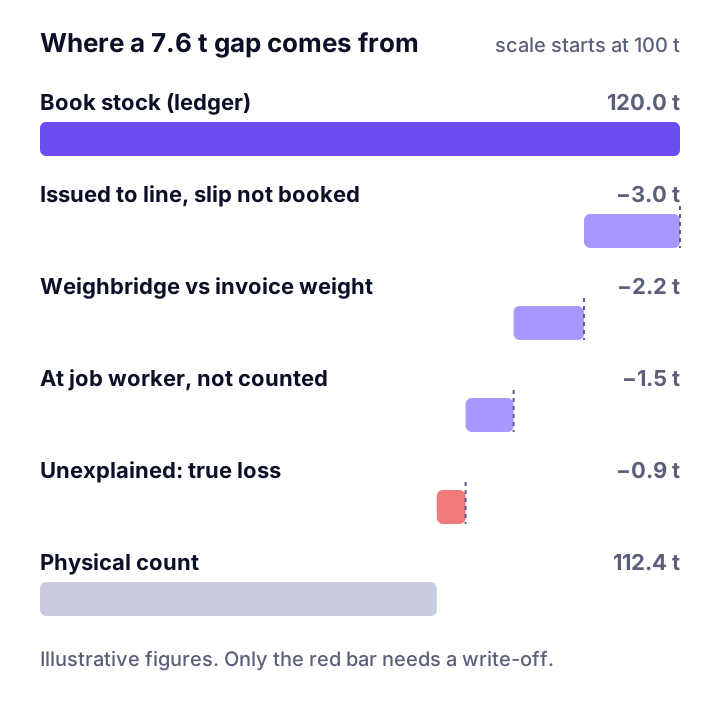
Only the 0.9 t needs a write-off. Its value is 0.9 × ₹58,000 = ₹52,200. The GST credit taken on it was 18% of that, so ₹9,396 goes into Table 4(B)(1) of GSTR-3B. If the team had written off the whole 7.6 t, it would have reversed ₹79,344 of credit and hidden three process faults that will repeat next year.
The gap is also 6.3% of the coil class (7.6 ÷ 120). That matters for the audit check below.
The monthly reconciliation checklist
Run this every month for high value items and before every full count. It takes the example above and turns it into steps.
- Fix a cut-off. Stop receipts, issues and dispatches for the count, or note the last document number of each type.
- List every location. Main store, line side stock, scrap yard, each job worker, goods in transit and other plants.
- Count in the stock unit. Weigh bulk material on the same weighbridge you book receipts on. Measure stockpiles by survey, not by eye.
- Get job worker statements. Match them to your open challans and the last ITC-04.
- Compare item by item and value the gap. Sort by rupee value, not by quantity. Look at the top 20 items first.
- Clear pending papers. Unbooked issue slips, receipts waiting for invoices, open transfers and returns.
- Sort what is left. Timing gap (pass the missing entry), process loss (book to production against a norm), true loss (write off) or excess (find the missing receipt).
- Approve, post and reverse. Get a named approver for each write-off. Reverse GST credit on true losses in Table 4(B)(1).
- Fix one cause. Pick the largest explained gap and change the process that created it.
Excess stock needs the same care as a shortage. Do not just pass a gain entry. An excess often means a purchase was received without being booked, so the supplier's invoice and your credit are both waiting somewhere.
Where stock reconciliation goes wrong
Most failures are about habit, not software.
- One big adjustment in March. A single "stock adjustment" entry makes the books match and hides every cause. The gap comes back next year.
- Counting only the main store. Line side stock, scrap and job work stock get missed, so you report false shortages.
- Writing off book only gaps. If the goods exist and only an entry is missing, fix the entry. A write-off then forces a GST reversal you did not owe.
- Ignoring the audit test. CARO 2020 clause 3(ii) asks the auditor of a company whether management counts stock at reasonable intervals. It also asks whether gaps of 10% or more in any class of inventory were found and dealt with in the books. The link is an ICAI Board of Studies summary of the order.
- Stock statements to the bank built from Excel. The same CARO clause asks whether quarterly stock statements to banks agree with the books, where working capital limits exceed ₹5 crore. If the bank gets one figure and the ledger shows another, the auditor reports it.
A gap of 6.3% in the coil example is under the 10% line. Small gaps still cost money and still carry the Section 35(6) risk, so the 10% figure is a reporting line, not a safe level.
When accounting software is not enough for stock
If your gap is mostly entry problems, software helps only when it removes the typing. Accounting software can record stock well, as our Tally vs ERP guide explains. It struggles when issues happen on the line, receipts come off a weighbridge and stock sits at three job workers. Then every movement is a voucher someone has to remember to type.
An ERP closes the gap by tying each movement to a document the plant already uses: the production order, the gate entry, the job work challan. Costing then reads the same numbers, which is why stock errors show up in your product costing too. Our manufacturing ERP guide covers what a full system adds.
ZapNexa, our manufacturing ERP, tracks stock by warehouse and bin with batch, serial and expiry control. It prints barcode and QR labels and scans them with a phone camera, runs cycle counts, and issues job work challans with ITC-04, as listed on the ZapNexa page. Test any system, ours included, with your own count sheet from last year.
Frequently asked questions
What is the difference between physical stock and book stock?
Book stock is the quantity your accounts or ERP say you hold. It is opening stock plus receipts minus issues and sales. Physical stock is what you find when you count, weigh or measure the goods. The two should match. When they do not, either an entry is missing or wrong, or goods were lost.
Do I have to reverse GST input tax credit on a stock shortage?
Only on goods that are actually lost, stolen, destroyed or written off. Section 17(5)(h) of the CGST Act blocks credit on those goods. Report the reversal in Table 4(B)(1) of GSTR-3B, as Circular 170/02/2022-GST explains. A gap that is only a missing entry needs the entry, not a reversal. Confirm the treatment with your CA.
How do I adjust a physical stock difference in Tally?
First clear pending purchase and sales bills, issue slips and transfers, since many gaps are timing. Then record the verified difference with a Physical Stock voucher, which resets the item's quantity to the counted figure. Book the value of any true loss to a loss account and reverse the GST credit on it.
How often should a factory count its stock?
There is no single legal interval. CARO 2020 asks auditors whether management counts at reasonable intervals. Many plants use cycle counts: high value items every month, middle items every quarter and the rest twice a year, with one full count before year end.
Put a number on stock control
Estimate what tighter stock, costing and billing control is worth to your plant before you talk to any vendor.