

An ERP RFP checklist for Indian manufacturers has six parts: your needs ranked as must-have or later, a GST and e-invoice test sheet, a fixed demo script, a five-year cost template, reference checks and a weighted scorecard. Send the same document to three to five vendors. Score every answer from 0 to 5.
Most guides online come from vendors or US consultants. They list generic questions and skip the parts that hurt in India: GST edge cases, Tally data, and a quote that looks cheap until year three. This post gives you a document you can copy today.
What should an ERP RFP include?
An ERP RFP should state who you are, what you need, how you will judge answers and what the vendor must price. It is a buying document, not a wish list. Keep it under 15 pages so vendors answer every line.
The sections below are the order that works. Each one maps to a step in the diagram.
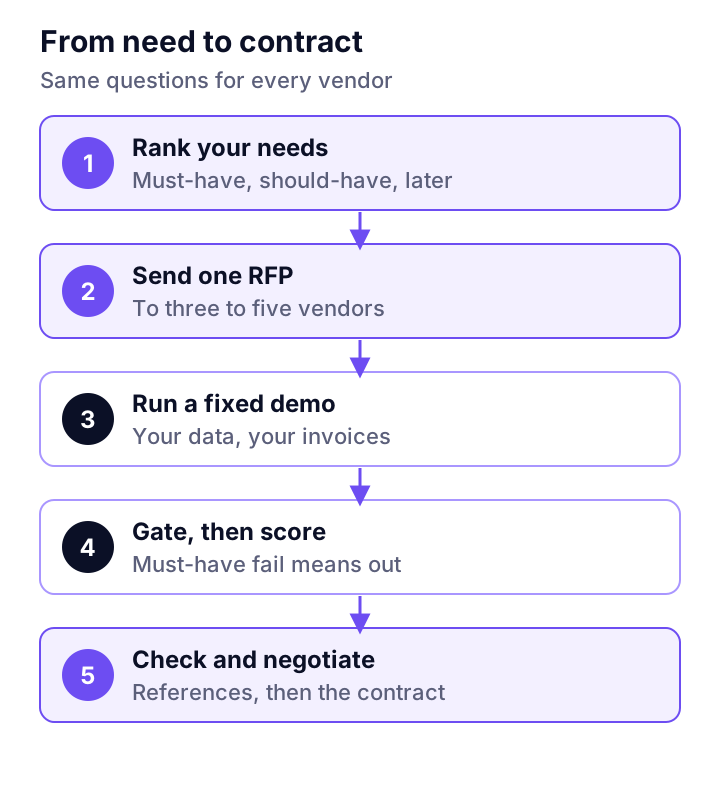
- Company snapshot. Plants, GSTINs, users by department, products, annual turnover band, current software (Tally, spreadsheets, an old ERP).
- Ranked requirements. Each line is marked must-have, should-have or later.
- India compliance. GST, e-invoice, e-way bill, TDS and the returns you file.
- Data and migration. What moves over: masters, open balances, stock, open orders.
- Integration. Weighbridge, machine data, bank, e-commerce, payroll.
- Commercials. A fixed price template, not free text.
- Support and delivery. Named team, hours, response times, location.
- Scoring method. Tell vendors how you will score. It keeps answers honest.
How do you rank requirements before you write anything?
Rank every line as must-have, should-have or later, and keep must-haves to about 15. A must-have is something your plant cannot run a month without. If everything is a must-have, nothing is.
Ask each department head for the five things that hurt most today. Then ask finance for the five audit or tax items that must work on day one. Merge them. The result is your requirements sheet.
| Area | Example must-have | Example should-have |
|---|---|---|
| Sales and billing | GST invoice with e-invoice IRN | Customer-wise price lists |
| Stock | Batch and location-wise stock | Barcode scanning |
| Production | Bill of materials with scrap and by-products | Shop floor tablets |
| Finance | Standard and actual costing per batch | Budget vs actual dashboards |
| Dispatch | E-way bill from the invoice | Weighbridge ticket link |
If you run more than one site, add a line on inter-plant transfers and one chart of accounts. Our guide to multi-plant ERP set-ups shows what to ask.
Which GST questions belong in an Indian ERP RFP?
Ask the vendor to show, not tell, five GST cases: e-invoice at the IRP, the 30-day reporting limit, a cancelled IRN, an e-way bill from the invoice, and a credit note linked to its IRN. Rules change, so check each against the official notice.
Here is what to quote in your document. E-invoicing applies to B2B supplies for taxpayers above ₹5 crore aggregate turnover, under Notification No. 10/2023 (Central Tax) on the CBIC site. The Invoice Registration Portal is at the e-invoice portal. Goods movement above ₹50,000 needs an e-way bill from the e-way bill portal. From 1 April 2025, taxpayers at ₹10 crore and above cannot report an invoice more than 30 days after its date.
Our guide on GST e-invoicing and what your ERP must handle has an eight-point test sheet. Paste it into the RFP as an annex.
Ask in writing: "Who updates the software when a GST rule changes, how fast, and is it in the licence fee?" A vendor that hesitates is telling you something.
What should the demo script ask the vendor to do?
Give every vendor the same script and your own sample data, and let them show it live. Slides prove nothing. A fixed script makes demos comparable and stops a smooth presenter from winning by charm.
Use real shapes from your plant:
- Create a sales order for a customer with a special price, then raise a GST invoice with e-invoice and e-way bill.
- Receive material against a purchase order with a short quantity and a batch number.
- Issue material to a work order, record scrap, and show the cost of the finished batch.
- Show stock by batch and by location, then transfer stock to another plant.
- Cancel an invoice after the IRN is made, and show what the ERP does.
- Import a Tally ledger and stock file, and show what failed.
- Run a user with no accounts rights and show what they cannot see.
Score the demo during the call. Do not wait until the next day. Each person on your panel scores alone, then you compare. If two scores differ by 2 points or more, talk about it. That is where the real findings are.
Ask for the sandbox too. Two days of your accounts clerk using it will teach you more than two hours of slides.
What questions should you ask an ERP vendor?
Ask questions that a salesperson cannot answer with "yes, we do that." Ask for a name, a number or a screen. Here are the ones that separate vendors.
- Is the product built for manufacturing, or is manufacturing an add-on to a generic ERP?
- How many customers in my industry and my state run it today? Can I call two?
- What was the longest delay on a go-live in the last two years, and why?
- Who exactly will work on my project? Can I meet them?
- What happens to my data and my price if I leave?
- What does a version upgrade cost, and what breaks in my custom changes?
- Is support in Hindi or my local language, and what are the hours?
- What is not in this quote that most customers end up buying?
The last question is the best one. It gets the extras on the table before you sign. Our ERP software cost guide for India lists the lines that often hide there.
How do you score ERP vendors? A worked example
Give each criterion a weight that adds to 100, score every vendor 0 to 5, and add the weighted points. The figures below are illustrative, for a plant with one site, 60 users and a Tally history. They are not real vendor results.
Cost is scored by formula: 5 × (lowest five-year cost ÷ this vendor's five-year cost). Vendor C is lowest at ₹40 lakh, so it scores 5. Vendor B at ₹48 lakh scores 4.2. Vendor A at ₹62 lakh scores 3.2.
| Criterion | Weight | Vendor A | Vendor B | Vendor C |
|---|---|---|---|---|
| GST and India compliance | 20 | 5 | 4 | 3 |
| Manufacturing fit (BOM, stock, costing) | 25 | 3 | 5 | 4 |
| Data migration from Tally | 10 | 4 | 3 | 3 |
| Support and references | 15 | 4 | 3 | 5 |
| Five-year cost | 20 | 3.2 | 4.2 | 5 |
| Implementation plan and team | 10 | 4 | 3 | 4 |
| Weighted total (out of 100) | 75.8 | 78.8 | 81 |
Each cell is weight × score ÷ 5. For Vendor C, compliance gives 20 × 3 ÷ 5 = 12 points, and fit gives 25 × 4 ÷ 5 = 20 points.
Vendor C wins on points. But it scored only 3 on GST. If your gate says "GST and compliance must score at least 4", Vendor C is out and Vendor B wins. That is why you set the gate before you see prices. A cheap quote should not buy its way past a must-have.
What should the five-year cost template look like?
Make every vendor fill the same table: licence or subscription, implementation, data migration, training, customisation, support and upgrades, for years one to five. Free text lets costs hide. A fixed grid does not.
| Cost line | Year 1 | Year 2 | Year 3 | Year 4 | Year 5 |
|---|---|---|---|---|---|
| Licence or subscription | |||||
| Implementation and set-up | |||||
| Data migration | |||||
| Training | |||||
| Custom changes | |||||
| Support and upgrades | |||||
| Your own staff time (add this yourself) |
Add your own staff time. A finance clerk who spends three months on testing is a cost, even if no invoice says so. Then check whether the ERP pays back with our ERP ROI calculator.
Where does an ERP RFP go wrong?
An RFP fails when it is too long, too vague or too late. These are the common ways.
- Too many must-haves. Vendors say yes to all and mean none. Cut the list.
- The RFP is copied from a US template. It has no GST, no e-way bill and no Tally import. Add them.
- Demos run without your data. Every demo then looks perfect.
- The scores are set after the prices arrive. People then bend weights to pick their favourite.
- No one owns the project. Name one project owner from your side before you send the RFP. Our ERP implementation checklist covers what that person does after the choice.
- Reference calls are skipped. Call two customers of similar size. Ask what went wrong, not what went well.
An RFP is also not always the right tool. If you have 15 users and a simple billing need, a short comparison of two or three options may be enough. If the real question is whether you need an ERP at all, start with Tally vs ERP, then come back here.
What to do this week
Start with your must-have list, because every later step depends on it.
- Book one hour with each department head and write the top five pains.
- Write the 15 must-haves and mark the GST ones.
- Copy the demo script above and swap in your own products.
- Fix your weights and your gate before any vendor sends a price.
- Read the pillar guide on what manufacturing ERP is if your team needs a shared picture first.
Frequently asked questions
What should an ERP RFP include?
Your company and plant details, a ranked list of requirements, India compliance needs (GST, e-invoice, e-way bill), data migration scope, integration needs, a fixed pricing template for five years, support terms, and the scoring method. Send the same document to every vendor so answers can be compared line by line.
How many vendors should get an ERP RFP?
Three to five. Fewer than three gives you no price pressure. More than five buries your team in demos and the scores stop meaning much. Cut a long list down using a one-page filter on GST support, industry fit and size before you send the full RFP.
How do you score ERP vendors?
List criteria, give each a weight so the weights add to 100, and score every vendor from 0 to 5 on each one. Multiply, add up, and compare. Add a pass mark for must-haves, so a vendor with a cheap price cannot win if it fails GST or stock basics.
Should the cheapest ERP quote win?
No. Compare the five-year cost, which includes licences, implementation, training, support and upgrades. Give price a weight, not a veto. A quote that is ₹8 lakh lower but fails one must-have costs more once you add the workaround.
Put a number on the business case
Before you send the RFP, estimate what better stock, costing and billing control is worth to your plant with our free ERP ROI calculator.