

The best ERP for manufacturing in India depends on your plant type, not on a ranking. A single-site shop below ₹5 crore turnover can often run on accounting software with BOM and job work. A plant that plans production needs an ERP with MRP and e-invoicing. A group with several plants or GSTINs needs multi-GSTIN stock transfers and consolidation.
Most "top 10 ERP" lists you will find are written by a vendor that ranks itself first, then copied to a dozen sites. None of them asks what you make, how many GSTINs you have, or whether you trace heats and batches. This guide starts there. It gives you a decision table, the Indian rules that cut a shortlist, a fair list of options and three worked examples.
How do you pick the best ERP for manufacturing in India? Start with your plant
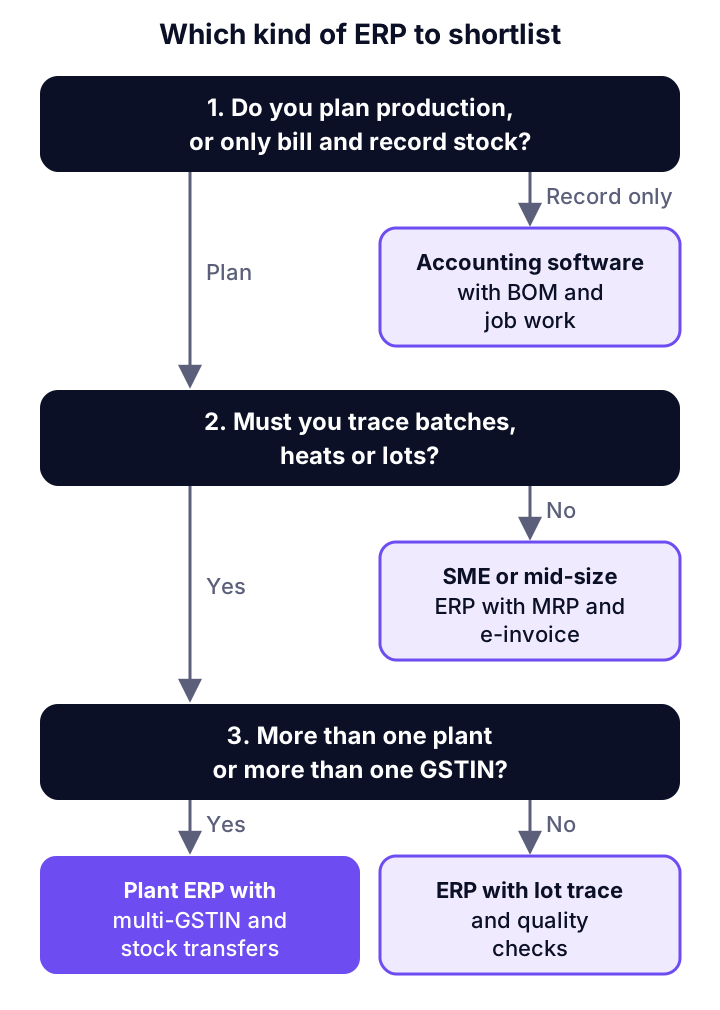
Pick the ERP category first, then the vendor. Three questions sort almost every Indian plant: do you plan production or only record it, must you trace lots, and how many plants or GSTINs do you run.
| Plant type | What breaks first | Shortlist this kind of system | Skip it when |
|---|---|---|---|
| Job shop or small unit, one site | Stock and job work registers in Excel | Accounting software with BOM and job work | You plan production from customer orders |
| Discrete engineering, auto parts, fabrication | Material shortages, late orders, cost per part | ERP with MRP, routings and e-invoice | You make only a few products in long runs |
| Process plant (steel, cement, chemicals, food) | Batch and heat trace, yield, quality records | ERP with lot trace, quality checks and weighbridge links | You have no lots to trace |
| Group with several plants or GSTINs | Inter-plant transfers, separate books, consolidation | Plant ERP with multi-GSTIN, transfers and consolidated statements | Each plant is a truly separate business |
| Distributor that also assembles | Batch and expiry, godown transfers, credit | ERP with warehouse and batch control | Assembly is a small side line |
If you are not sure whether you have outgrown your books at all, read the signs a plant has outgrown Tally first. For the basics of what a plant ERP covers, see our manufacturing ERP guide.
Which Indian rules should filter your ERP shortlist?
Four rules change what an Indian manufacturer needs from software. Your turnover decides which ones apply. Check each against your own numbers with your CA.
| Rule | Who it applies to | Since | What the ERP must do |
|---|---|---|---|
| GST e-invoicing | Aggregate turnover above ₹5 crore (Notification 10/2023 Central Tax) | 1 August 2023 | Send each B2B invoice to the IRP and print the IRN and QR code |
| 30-day reporting limit | Aggregate turnover of ₹10 crore or more (GSTN advisory) | 1 April 2025 | Warn you before an invoice passes 30 days unreported |
| ITC-04 for job work | Above ₹5 crore files half-yearly, others yearly (Notification 35/2021 Central Tax) | 1 October 2021 | Track every challan sent to and back from job workers |
| Audit trail in accounting software | Companies, under the Companies (Accounts) Rules (ICAI explainer) | Years from 1 April 2023 | Keep an edit log that cannot be switched off |
The audit trail rule is easy to miss. Your books may have an edit log, but stock and production kept in Excel have none. That gap is often the real reason to move. For the full e-invoice flow and test cases, see what your ERP must handle for GST e-invoicing.
Which ERP options fit Indian manufacturers? A fair list
Every option below can work for the right plant. The "watch out" column is where each one is the wrong pick. Facts come from each vendor's own documents, linked in the table. We have left out prices, because none of these vendors publishes one that fits every plant.
| Option | Fits best | Watch out |
|---|---|---|
| TallyPrime | One site that records stock, BOM and job work orders | It does not plan production from orders |
| Zoho Books and Inventory | Trading and light assembly | Limited for heavy shop floor control (our comparison) |
| ERPNext with India Compliance | Plants with their own IT team that want open source | GST API features in the India Compliance app need a paid account |
| Odoo | Discrete plants that want to add modules over time | Its India localisation covers e-invoice and e-way bill, but check partner support near you |
| Microsoft Dynamics 365 Business Central | Mid-size firms with a good Microsoft partner | The India features list GST, TDS, TCS, subcontracting and gate entry; plant fit depends on the partner |
| SAP Business One | Larger firms with budget and an SAP partner | Longer and heavier rollout for an MSME (our comparison) |
| Indian plant ERP built for heavy industry | Steel, cement, mining and other process plants | Smaller vendors: check references at plants like yours |
Two things matter more than the name on the box. First, who will implement it in your city, and have they done a plant like yours? Second, can you see your own data in the demo? Our ERP RFP checklist gives a demo script and a scorecard for exactly this step.
Three Indian plants, three different answers
The three plants below are illustrative. The numbers are realistic for Indian plants but do not describe any customer. They show how the same question gets three answers.
Plant A: fabrication shop, ₹3.5 crore turnover, one site
It makes structural parts to order and sends them out for galvanising. Below ₹5 crore, e-invoicing is not yet compulsory and ITC-04 is filed once a year. The pain is a job work register in Excel that never matches the galvaniser's challans.
Answer: accounting software with job work and BOM. TallyPrime fits. Plan the next step for the year turnover crosses ₹5 crore, because e-invoicing and half-yearly ITC-04 both start then.
Plant B: auto component machining, ₹45 crore turnover, one site
It holds 400 part numbers, takes monthly schedules from two OEMs and sends parts out for heat treatment and plating. E-invoicing applies, the 30-day limit applies, and ITC-04 is half-yearly. The pain is shortages found on the day of dispatch and no lot trace when a customer rejects a batch.
Answer: an ERP with MRP, routings, lot trace, quality checks and job work challans. Odoo, Business Central or an Indian plant ERP could all fit. The deciding test is a demo on their own BOMs and one OEM schedule.
Plant C: sponge iron and captive power, ₹300 crore, two plants in two states
Each plant has its own GSTIN. Coal and ore come in over weighbridges, and material moves between the plants. Supplies between two GSTINs of the same company are taxable under Schedule I of the CGST Act, so every transfer needs a tax invoice and an e-invoice. The pain is two sets of books and a month-end that takes ten days.
Answer: a plant ERP with multi-GSTIN books, stock transfers with tax, weighbridge capture and consolidated statements. Read how a multi-plant ERP handles several sites and weighbridge integration with ERP before any demo.
| Plant A | Plant B | Plant C | |
|---|---|---|---|
| E-invoice | Not yet | Yes | Yes, transfers too |
| 30-day limit | No | Yes | Yes |
| ITC-04 | Yearly | Half-yearly | Half-yearly if job work |
| Kind of system | Accounting with job work | ERP with MRP and lot trace | Plant ERP, multi-GSTIN |
A two-hour shortlist filter you can use today
Run this before you call any vendor. It turns a list of twenty names into three or four.
- Write down your turnover, number of plants and number of GSTINs.
- Mark which of the four rules above apply to you.
- Answer the three questions in the decision flow and note your box.
- List your top five pains by department, in one line each.
- Remove any option whose own documents do not show the rules you marked.
- Remove any option with no implementer who has done a plant like yours.
- Ask the rest for a demo on your own data, using one real order from start to invoice.
- Ask each for a five-year cost, then compare with our guide to ERP software cost in India.
Where "best ERP" choices go wrong
Most bad ERP choices come from buying the brand, not the fit. These five patterns are common in Indian plants.
- Buying for the plant you hope to be. A ₹20 crore unit buys an enterprise suite and pays for modules it will not use for years.
- Buying for the plant you were. A plant that crossed ₹10 crore keeps adding Excel sheets beside its books, and the 30-day e-invoice limit starts to bite.
- Judging by the demo deck. Generic demos always work. Your own BOMs, units and GST cases are where gaps show.
- Ignoring the implementer. The same ERP can go well or badly depending on the partner's plant experience.
- Moving everything at once. A phased move, one module at a time, is slower on paper and safer in practice. Our ERP implementation checklist covers the order.
This guide has limits. It cannot rank vendors on quality we have not tested at your plant. Treat it as a way to build a shortlist, then let your own demo and references decide.
Where ZapNexa fits
ZapNexa is our manufacturing ERP for Indian factories, so weigh this section with that in mind. It fits Plant B and Plant C in the examples above. It covers production planning with MRP and a shop floor terminal, quality checks, job work challans with ITC-04, and GST e-invoice and e-way bill. Each company in a group keeps its own GSTIN and books, with stock transfers and consolidated statements. It can read Tally data so a move happens one module at a time. It is not the right pick for Plant A, where accounting software is enough. See ZapNexa manufacturing ERP for the full module list.
Frequently asked questions
Which is the best ERP for a small manufacturing business in India?
For a single site below ₹5 crore turnover that only needs to bill, record stock and send material for job work, good accounting software with BOM and job work, such as TallyPrime, is often enough. Move to an ERP with MRP when you start planning production from orders, or when stock and costing live in Excel beside the books.
Is Tally an ERP?
TallyPrime is accounting and inventory software with some ERP features, such as bills of materials, job work orders and e-invoice generation. It does not plan production from customer orders or run a shop floor. Many small plants run well on it. Plants that plan production usually need a full ERP.
Do I need an ERP for GST e-invoicing?
No. Any software that can send invoices to the Invoice Registration Portal (IRP) will do. E-invoicing has applied to businesses above ₹5 crore turnover since 1 August 2023. An ERP helps when the invoice, the stock movement and the e-way bill must all match without retyping.
How long does an ERP take to go live in an Indian plant?
It depends on modules, plants and data quality, so ask each vendor for a plan with named phases. A phased rollout that starts with the module causing the most pain lowers the risk. Our implementation checklist lists what to settle before day one.
Put a number on the case first
Estimate what better stock, costing and billing control is worth to your plant before you call any vendor.