

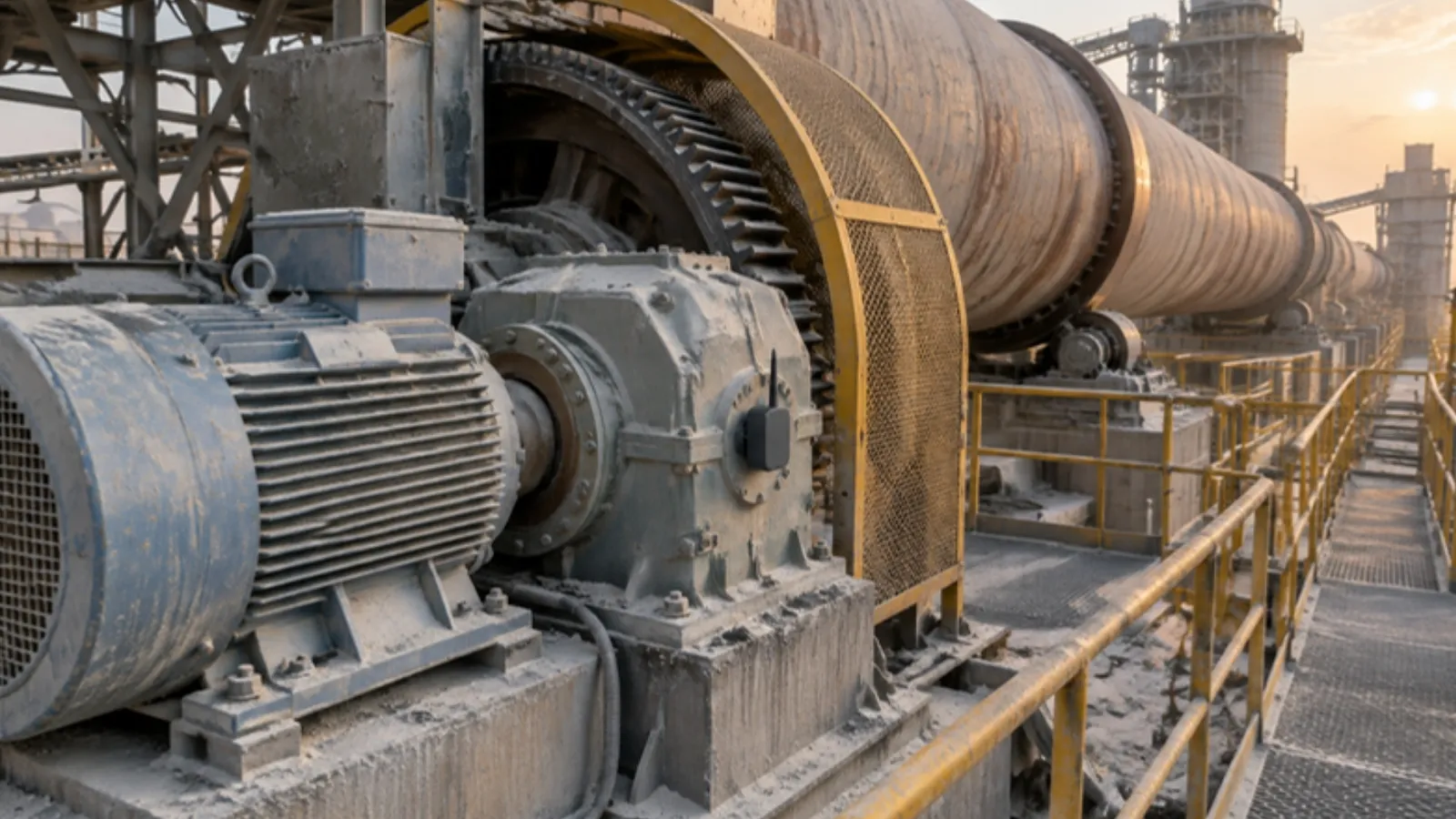
Predictive maintenance in a cement plant starts with the machines whose stop is a kiln stop: the preheater ID fan, the kiln drive and girth gear, the tyres and support rollers, and the cooler fans. The raw mill VRM comes next. Slow kiln parts turn below the 120 r/min floor of ISO 20816-3, so they need their own checks.
Most plants already log more than they use. The DCS holds kiln drive power, mill differential pressure (ΔP), fan current and many bearing temperatures. Fuller Technologies, formerly FLSmidth Cement, says most kilns run with only a few isolated sensors and a full inspection every 2–3 years (Fuller, Online Reliability Services for Kilns). So the gap is not data. It is knowing which signal to watch on which machine, and which alarm rule separates a process upset from a failing part. This post is that plan, machine by machine. If you are new to sensors and pilots, start with our guide to predictive maintenance and industrial IoT.
Which cement plant machines should you monitor first?
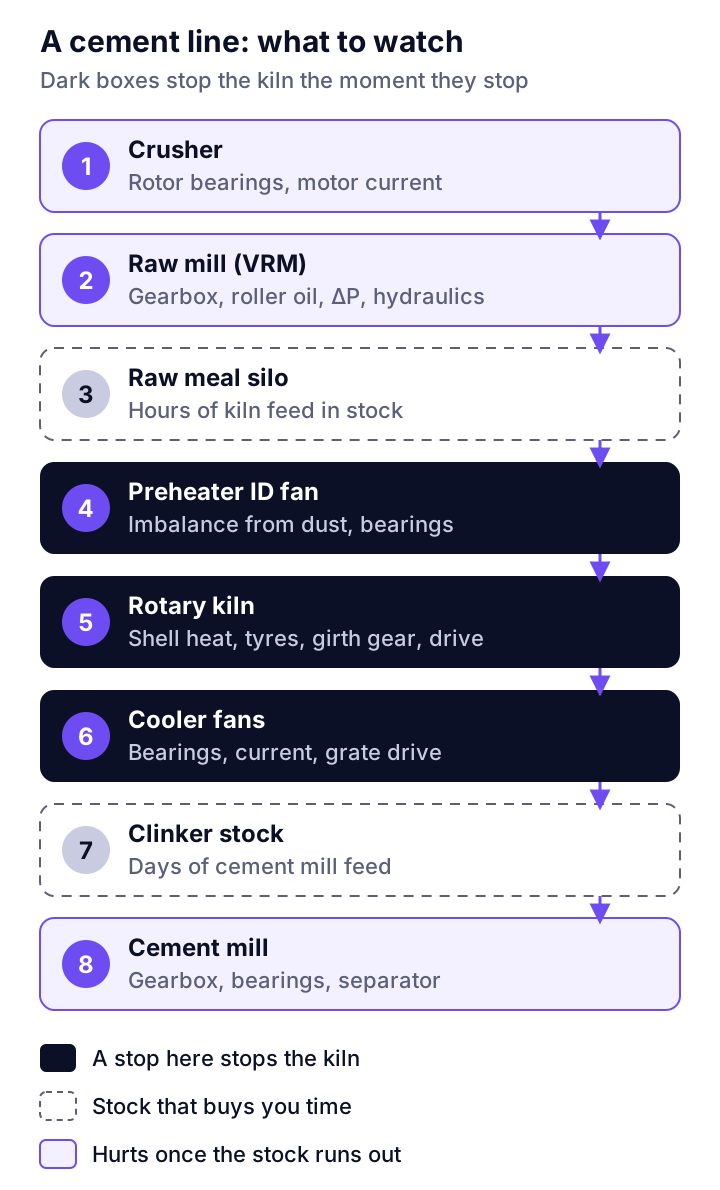
Rank machines by the kiln hours their failure would cost, not by motor size. A machine with no stock after it takes the kiln down with it. A machine with a silo or a yard after it only hurts once that stock runs out.
A cement line has two big buffers. The raw meal silo holds some hours of kiln feed, so a raw mill stop does not stop the kiln at once. The clinker yard usually holds days of cement mill feed, so a cement mill stop rarely touches the kiln at all. The coal mill has a smaller buffer in its fine coal bin. Nothing sits between the preheater ID fan, the kiln and the cooler fans. If any of those stops, the kiln stops.
A worked ₹ example: kiln hours decide the order
The figures in this example are illustrative. Replace them with your own repair times, silo levels and margins. Assume one hour of kiln stop costs ₹4 lakh in lost clinker contribution, and the raw meal silo holds 24 hours of kiln feed.
| Failure (illustrative) | Repair time | Stock before the kiln stops | Kiln hours lost | Cost at ₹4 lakh per hour |
|---|---|---|---|---|
| Preheater ID fan bearing seizes | 20 h | None | 20 | ₹80 lakh |
| Kiln pinion bearing fails | 36 h | None | 36 | ₹1.44 crore |
| VRM accumulator loses its gas charge | 8 h | 24 h of raw meal | 0 | Mill output only |
| VRM gearbox bearing fails | 72 h | 24 h of raw meal | 48 | ₹1.92 crore |
| Cement mill gearbox bearing fails | 72 h | Days of clinker | 0 | Dispatch risk only |
Two things stand out. The same VRM sits low on the list for one fault and high for another, because only the long repair outlasts the silo. And the table leaves out restart cost: a kiln that stops must burn fuel to come back to temperature, so the real number is higher. Run your own figures through our downtime cost calculator before you buy a single sensor.
Why do standard vibration limits not fit the kiln or the VRM table?
Because those parts turn too slowly. ISO 20816-3:2022 covers coupled industrial machines above 15 kW that run between 120 and 30,000 r/min (ISO 20816-3 scope, Estonian Centre for Standardisation). A conventional preheater kiln turns at about 2.5 to 3.5 rpm at most (US patent 4,578,029). The shell, tyres, support rollers and girth gear are far outside the zone tables.
Slow bearings also make weak impacts. A 2025 conference paper for the British Institute of Non-Destructive Testing notes that bearings below about 100 r/min are harder to monitor with ordinary vibration methods, which is why acoustic emission is used on them (Bradshaw, BINDT CM 2025). For these parts, trend temperature, position, runout, drive power and oil condition instead.
Keep velocity zones for the fast end of each drive: motors, gearbox input shafts and fans. Our ISO 10816 vibration thresholds explainer covers those zones, and the vibration threshold lookup gives the zone for a reading. One catch for fans: the ISO 20816-3 scope says its criteria generally apply only to fans above 300 kW. For smaller fans, use the fan maker's limits.
| Part | Speed | What to trend |
|---|---|---|
| Kiln shell, tyres, support rollers | A few rpm | Shell temperature, tyre creep, roller bearing temperature, axial position |
| Girth gear and pinion | Low | Runout, pinion bearing vibration, gear mesh, lubrication |
| VRM table and rollers | Low | Roller return oil temperature, ΔP, hydraulic pressure, vibration once per table turn |
| Motors, gearbox input shafts, large fans | Usually above 120 r/min | ISO 20816-3 velocity zones, bearing envelope, motor current |
What should you monitor on the kiln?
Six things: shell temperature, tyre creep, support roller bearings, axial float, the girth gear and pinion, and drive power. Fuller's kiln monitoring package lists much the same set, and notes that it uses existing control system signals where it can (Fuller kiln brochure).
| Part | Signal | What it catches | Alarm logic |
|---|---|---|---|
| Shell | Shell scanner temperature by section | Lost coating or refractory (a hot spot) | Rise against the same section's history and its neighbours |
| Tyres | Tyre creep (migration) per turn | Shell ovality, which shortens lining life | Change from the creep you see in steady running |
| Support roller bearings | Bearing temperature, roller deflection | Overload, poor lubrication, skewed rollers | Compare with the partner roller on the same pier |
| Hydraulic thrust device | Axial position, cycles, hydraulic pressure | Kiln stuck at one end, uneven roller wear | No up and down cycle within the set time |
| Girth gear and pinion | Radial and axial runout, pinion bearing vibration | Misalignment, reduced tooth root clearance, tooth damage | Rising runout trend; new gear mesh sidebands |
| Drive | Motor power or current | Extra load from coating build-up or mechanical drag | Power against feed rate and kiln speed |
A few field notes. Shell scanner readings depend on emissivity, and ISO 18434-1 sets out how thermography should correct for it. Do not set one fixed shell limit for the whole kiln. The burning zone and the inlet run at very different temperatures, so each section needs its own baseline. Near the piers, heat kills cheap sensors and cables. Mount transmitters away from the shell, shield cable runs, and check them after every shutdown.
What should you monitor on a vertical roller mill?
Treat the VRM gearbox like any large gearbox, but never read mill vibration on its own. Most VRM vibration starts in the process. Ahmed Seaf of FLSmidth Cement makes this point in Global Cement Magazine (October 2025): vibration is usually the symptom, and the bed, the feed or the hydraulics are the cause.
| Part | Signal | What it catches |
|---|---|---|
| Main gearbox | Input shaft vibration, thrust pad and bearing temperatures, oil supply temperature, oil samples | Bearing and gear wear, poor cooling |
| Rollers | Return oil temperature, oil level, oil contamination | Roller bearing distress, blocked oil supply |
| Hydraulics | Cylinder pressure, accumulator pre-charge, oil cleanliness | Lost damping, sticky valves |
| Process | ΔP, feed rate, mill motor power, water spray rate | A bed that is too thin or too thick |
| Separator drive | Motor and gearbox vibration, motor current | Bearing faults, imbalance, rotor bar faults |
This list follows the fault list in Fuller's VRM monitoring brochure. For hydraulic oil, ISO 4406 gives the code for reporting particle counts, so your lab results stay comparable from one sample to the next.
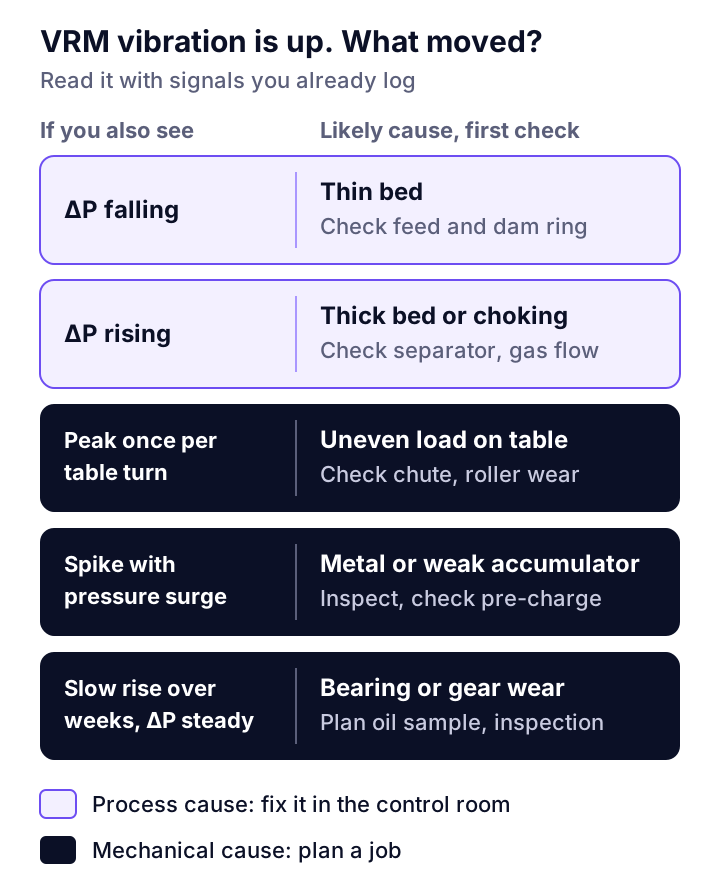
Seaf's article gives the pairs behind this chart. Low ΔP with rising vibration means a thinning bed. High ΔP points to a thick bed or a blockage. Uneven feed on the table shows up as a peak once per revolution. Metal in the mill causes sharp spikes and hydraulic pressure surges. A weak accumulator passes every feed surge straight into the structure.
Two more points matter for the alarm design. First, mill body vibration sensors react with a time lag when drive torque rises, so a trip based on them alone may come late for the gearbox (Siemens, US patent 10,118,181). If your drive gives torque or speed, log it too. Second, water spray calms the bed, but in a cement mill it can pre-hydrate the cement and lower its strength (GCP Applied Technologies, US patent 11,684,929). A mill that needs more and more water to stay calm is telling you something. Log water flow as a signal.
In India, expect more process alarms in the monsoon. Wet limestone, fly ash and gypsum change the feed moisture, and Seaf names sudden moisture changes as a cause of an unstable bed. Fix the feed. Do not widen the gearbox limits to quiet the noise.
What should you monitor on ID fans, cooler fans and bag-house fans?
Watch vibration at running speed for imbalance, bearing vibration and temperature, and motor current. On a preheater ID fan, the usual enemy is dust that sticks to the impeller and then breaks off in lumps.
Plant Engineering names preheater ID fans in cement as a case where build-up is a regular problem. It notes that backward-curved blades help control it. The same article warns about thermal bow after a stop. A rotor left still in a hot casing can bow from as little as a 1°F difference between the top and bottom of the shaft. The result is high vibration at start-up that fades as the rotor warms. Turn the rotor slowly during stops, and give the first minutes after a start their own alarm band.
For the fans, these rules work well:
- ID fan: alarm on a step change in running-speed vibration or phase, not just on a slow rise. A lump breaking off is a step.
- Cooler fans: a grate cooler has many fans in a row. Compare each fan with its neighbours at the same damper position, so one sick fan stands out.
- Bag-house fan: trend current against damper position. A change in that link points to the fan, the ducting or the filter bags.
- Motors: current signature analysis, covered by ISO 20958:2013, finds rotor bar faults, and some faults in the driven load, from measurements at the motor supply. It is useful where a sensor on the fan itself is hard to fit.
How do you set alarms that separate a process upset from a failing part?
Pair every mechanical signal with a process signal, and alarm on change from each machine's own baseline. A fixed number alone will flood a cement plant with alarms that operators learn to ignore.
- Gate by running state. No alarm while the machine is stopped, starting, or on its barring drive.
- Pair the signals. Vibration with ΔP and feed on the VRM. Bearing temperature with load and ambient on the kiln piers. Fan vibration with damper position and current.
- Use the machine's own baseline. This matters most on slow parts, where no standard zones exist.
- Require persistence. The condition must hold for a set number of readings before it alarms.
- Use two levels. A watch level goes to the reliability engineer. An action level opens a maintenance notification. Our guide to routing alerts into maintenance work orders covers that hand-off.
- Write the first check into the alarm. "Check accumulator pre-charge" helps a night-shift fitter more than "VRM vibration high".
Where this goes wrong
- Copying zone tables onto slow parts. A kiln support roller will never cross a velocity zone, even when its bearing is failing.
- Monitoring the VRM like a fan. Without ΔP and feed alongside, every feed change raises an alarm, and the control room mutes it within a week.
- Sensors cooked or buried. Kiln heat and cement dust kill cheap sensors, cables and connectors. Budget for heat shields, sealed housings and proper cable routes.
- Weak plant networks. Many plants sit far from towns on one patchy link. Data must be buffered at the edge and sent once the link returns.
- Buying sensors before ranking machines. Rank by kiln hours lost first. It is the same lesson as in why predictive maintenance pilots fail.
- When not to bother. A cement mill with days of clinker ahead of it and a second mill beside it may need nothing more than monthly route readings.
Where Vexron fits
Vexron reads tags from the PLCs and control systems a plant already has, over Modbus, Siemens S7, OPC-UA and EtherNet/IP. So kiln drive power, mill ΔP and bearing temperatures can sit next to new vibration data in one place. Its edge layer computes RMS velocity, peak acceleration, crest factor and kurtosis, and holds more than 100,000 records when the network drops. The VMI-1 model uses vibration, temperature and power data to flag bearing wear, misalignment, imbalance and looseness, and points to the frequency band behind each alert. Vexron also shows downtime loss in rupees. It is not a kiln shell scanner or an acoustic emission kit; if your scanner shares its readings over OPC-UA or Modbus, Vexron can read them like any other tag. Our cement industry page shows how Vexron and ZapNexa fit a cement plant.
Frequently asked questions
Which equipment should a cement plant monitor first?
Start with the machines whose stop is a kiln stop: the preheater ID fan, the kiln drive and girth gear, the tyres and support rollers, and the cooler fans. Then rank the mills by how long a repair would outlast the stock after them. A raw mill with a full raw meal silo can be down for hours without touching the kiln. A cement mill usually has days of clinker ahead of it.
Can ISO 10816 or ISO 20816 vibration limits be used on a cement kiln?
Not on the slow parts. ISO 20816-3:2022 covers coupled machines running between 120 and 30,000 r/min. A kiln shell turns at a few rpm, so its tyres, support rollers and girth gear fall outside the zone tables. Use temperature trends, runout, axial position and drive power there. Keep the velocity zones for motors, gearbox input shafts and large fans.
Why does a vertical roller mill vibrate?
Usually because the grinding bed is unstable, not because a part has failed. Feed surges, wet or hard material, a bed that is too thin or too thick, worn rollers or table liners, weak hydraulic accumulators and metal in the feed are the common causes. Read the vibration together with mill differential pressure, feed rate and hydraulic pressure before you plan a gearbox job.
Our line has very few sensors. Where do we start?
Start with the signals your DCS already logs: kiln drive power, mill differential pressure, fan current and bearing temperatures. Trend each one against the same machine's own history. Then add vibration sensors on the preheater ID fan, the kiln drive pinion bearings and the VRM gearbox, in order of the kiln hours each one puts at risk. Monthly route readings can cover the rest.
Put a rupee figure on one kiln hour
Before you choose which machines to instrument, work out what one hour of kiln stop costs your plant.
Downtime cost calculatorExplore Vexron