



The main motor bearing failure causes are poor lubrication, dirt or water getting in, bad fitting, misalignment or belt pull, and stray current from a VFD. SKF's bearing damage course puts about one third of failures down to lubrication and one sixth to contamination. Read the failed bearing before fitting a new one.
That last step is the one most plants skip. The fitter changes the bearing at 2 a.m., the old one goes in the scrap bin, and the same motor stops again in three months. The same SKF course says most bearings, about 90%, outlive the machine they are fitted to. So a bearing that fails early is telling you something about the motor, the drive or the way it is looked after. This guide is for the maintenance head who wants the repeats to stop.
Motor bearing failure causes: the seven usual reasons
Seven causes explain almost every early bearing failure in an electric motor. Each one leaves its own mark on the bearing, so you can usually tell which one you have.
ISO 15243, the standard for bearing damage, sorts damage into six groups by what it looks like: rolling contact fatigue, wear, corrosion, electrical erosion, plastic deformation, and cracking. SKF's own investigation data, quoted in that article, found abrasive wear (26%), surface fatigue (16%), moisture corrosion (14%), adhesive wear (7%) and current leakage erosion (7%) were the most common. Only one of those is a bearing simply reaching the end of its life.
| Cause | What you see | Fix |
|---|---|---|
| Too little or old grease | Dark, dry or burnt grease. Housing runs hot and squeals. | Grease card with type, grams and hours from the motor plate |
| Too much grease | Grease pushed past seals. Heat rises right after greasing. | Fixed shots per interval; open the drain plug |
| Dust, coal or cement fines | Scored, dull track, gritty grease. Failures cluster in one dusty bay. | Better seals, clean nipples and guns |
| Water and humidity | Rust or brown stains. Failures after monsoon or wash down. | Sealed bearings, heaters or turning idle motors |
| Stray current from a VFD | Washboard flutes, grey frosted track, loud hum. Failure within months of a new drive. | Insulated bearing, shaft grounding, earthing |
| Misalignment or belt over tension | Wear path off centre. Coupling wear, belt squeal, high axial vibration. | Laser or dial alignment, belt tension gauge |
| Bad fitting or handling | Dents at ball spacing, cracked ring, creep marks. Failure soon after a bearing change. | Heater fit, check shaft and housing size |
The SKF course also says these shares change by industry. In paper mills, for example, contamination and poor lubrication cause more damage than fatigue. Expect the same in cement, sponge iron and coal handling, where fine dust gets into every gap.
Why motor bearings keep failing after you replace them
Motor bearings keep failing when the bearing is treated as the fault instead of the result. A new bearing fitted into the same conditions fails in the same way, often faster, because the shaft seat or housing was also damaged by the first failure.
Check for these repeat causes first. All of them are common in Indian plants:
- The bearing was heated on a gas flame or knocked on with a hammer. Uneven heat softens the ring. Hammer blows go through the balls and dent the races. Use an induction heater or an oil bath, and push only on the ring being fitted.
- The shaft or housing seat is worn. After a seized bearing, the inner ring often spins on the shaft. The seat wears oval. Measure it with a micrometer before fitting. A loose seat lets the ring creep and wear again.
- One grease gun for every motor. Mixing grease types can turn grease soft or hard. Mark each gun and each motor with the grease it takes. Wipe the nipple before every shot in dusty areas.
- Belt tension set by thumb. An over-tight V-belt puts a large side load on the drive end bearing. Use the belt maker's tension figure and a simple gauge.
- Alignment done with a straight edge. A straight edge misses angle errors. A dial or laser alignment kit finds them, and also finds soft foot (one motor foot not sitting flat).
- A new VFD on an old motor. The drive was fitted to save energy. Nobody added an insulated bearing or a grounding path. The bearing fails within months with fluting.
- Standby motors left still through the monsoon. A motor that does not turn for weeks gets moisture in the bearing. Nearby machines also shake it, which makes small dents at each ball. Turn standby motors by hand every week, or run them on a schedule.
If the same motor has failed twice in a year, stop and do a short root cause check before the third bearing goes in. The next section shows how.
How to read a failed bearing in 10 minutes
Bearing failure analysis does not need a lab for most motors. Keep the old bearing, clean one half carefully, and look at four things: the grease, the track, the marks and the fit.
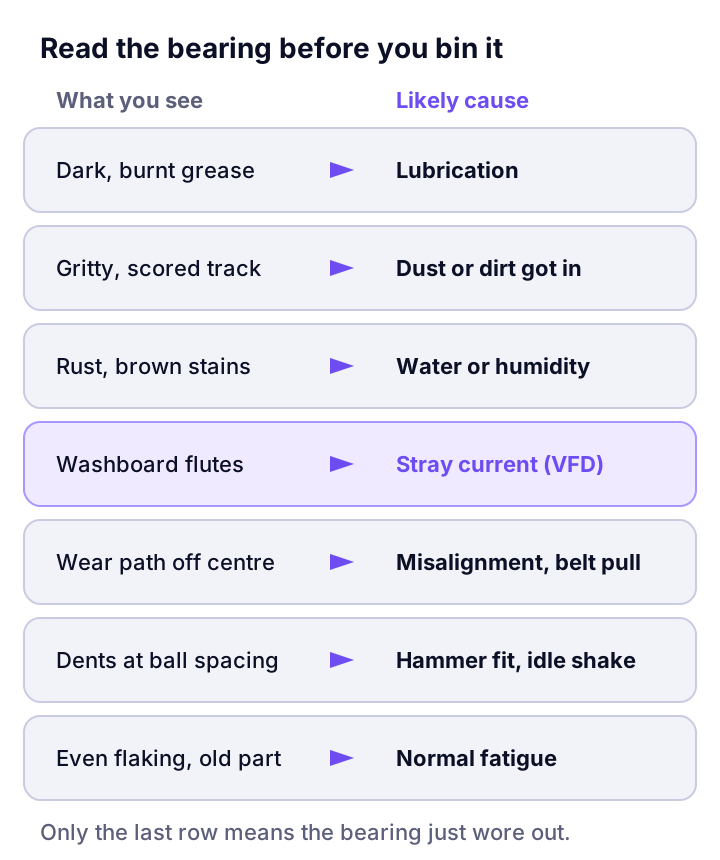
- Look at the grease before you clean anything. Note the colour and feel. Black and dry means heat or old grease. Gritty means dirt. Milky means water.
- Mark which end it came from. Drive end and non-drive end fail for different reasons. Belt pull loads the drive end. Current damage can show at either end.
- Look at the wear path on the outer ring. A centred, even path is normal. A path off to one side means axial load or misalignment. A path all the way round a stationary outer ring means heavy load or a tight fit.
- Look for the marks in the diagram above. Flutes, rust, dents and scoring each point to one cause.
- Check the bore and outside diameter for shine. Polished bands mean the ring was turning on the shaft or in the housing.
- Measure the shaft and housing seat before the new bearing goes on.
- Write it on the work order. Cause found, photo, and what was changed. Three of these records tell you more than any opinion.
One caution from the SKF ISO 15243 article: several damage types often overlap as the failure goes on. If the bearing ran until it seized, the first cause may be hidden under the last. That is a strong reason to catch the next one earlier.
Electric motor bearing failure on VFDs: how stray current does it
A variable frequency drive switches voltage very fast. That creates a voltage on the motor shaft, and the current finds the easiest path to earth, which is often through the bearings. Each tiny spark melts a small spot on the race. Thousands of them build a washboard pattern called fluting.
ABB's technical guide on bearing currents (guide number 5 in its drives guide book) describes the current paths and the fixes. In plant terms:
- Insulated bearing at the non-drive end breaks the circulating current path on larger motors.
- Shaft grounding brush or ring gives the current a path that is not the bearing.
- Proper motor cable and earthing, with a symmetrical shielded cable and a short, wide earth bond, cuts the current at the source.
- Check the driven machine too. If the motor bearings are insulated, the current can jump through the coupling into the gearbox or pump bearings instead.
A drive retrofit is often done for energy savings by the electrical team. The bearing failures show up later in the mechanical team's register. Put the bearing check on the drive commissioning sheet so the two teams see the same risk.
What a repeating bearing failure costs: a worked rupee example
The figures below are illustrative, not a customer result. Take a 75 kW motor driving a belt conveyor through a V-belt in a sponge iron plant. Its drive end bearing has failed every four months.
| Line | Per failure |
|---|---|
| Lost output: 5 hours at ₹30,000 contribution per hour | ₹1,50,000 |
| Bearings, seals and grease | ₹15,000 |
| Crane, overtime and contract fitter | ₹10,000 |
| Total per failure | ₹1,75,000 |
| Three failures a year | ₹5,25,000 |
Now the root cause fix. A belt tension gauge, one contractor laser alignment, a shaft seat repair and a written grease card might cost about ₹40,000 in total, plus two days of an engineer's time. If that removes two of the three failures in the first year, the plant saves about ₹3.5 lakh less the ₹40,000, roughly ₹3.1 lakh. It also removes the risk of a seized bearing damaging the rotor or the winding, which costs far more than a bearing.
Use your own contribution per hour and your own stop length. Our guide to calculating the cost of unplanned downtime shows which lines to include, and the downtime cost calculator does the sum.
How to catch motor bearing damage before it stops the machine
Bearing damage shows up in vibration first, then noise, then heat. High-frequency vibration and envelope readings rise weeks before the housing gets hot. Velocity in mm/s RMS rises later. By the time you hear grinding, the bearing is close to the end.
| Stage | What changes | How to catch it |
|---|---|---|
| Early | High-frequency acceleration, envelope | Online sensor or monthly route with an analyser |
| Middle | Bearing defect peaks, velocity starts to rise | Spectrum on the analyser, trend against the motor's own normal |
| Late | Noise, heat, velocity in alarm zone | Temperature gun, ear, ISO 10816 vibration zones |
| Failure | Seized or broken bearing | Too late |
For a few motors, a monthly route with a handheld analyser is enough. For motors whose stop halts a kiln, a mill or a dispatch line, continuous monitoring pays for itself sooner. Our vibration analysis basics explain what the sensors measure, and the predictive maintenance and industrial IoT guide shows how to pick the first machines.
If you want this on screen without adding a lot of new hardware, Vexron reads the PLC, SCADA and sensor data a plant already has. Its VMI-1 model learns how each machine normally runs and flags bearing wear, misalignment, imbalance and looseness, and it shows each stop in rupees. Our online vibration monitoring page covers the sensor side.
Where this goes wrong
Bearing analysis has limits, and it helps to know them before you trust a conclusion.
- A seized bearing hides its first cause. Heat and smearing at the end cover the early marks. Catch failures earlier and the evidence is cleaner.
- Two causes often work together. Misalignment raises the load, the grease runs hot and breaks down, and the bearing then fails from poor lubrication. Fix both.
- Over-greasing is a common reaction to a failure. After one failure the team adds more grease, and the next failure comes from heat. Follow the grams on the plate.
- Not every motor deserves this effort. A small motor with a standby, on a non-critical job, may be cheaper to run until it fails. Spend the time on motors whose stop costs real money.
- Monitoring does not fix the cause. A sensor tells you the bearing is going. Only the checks above stop the next one.
Frequently asked questions
Why does a new motor bearing fail within weeks?
Because the cause was never removed. The usual reasons are a bent or worn shaft seat, a hammer fit, too much belt tension, a misaligned coupling, or the wrong grease. Check the old bearing first, then measure the shaft and housing fits and the alignment. A new bearing in the same conditions fails the same way.
Can a VFD damage motor bearings?
Yes. The fast switching of a variable frequency drive can push current through the motor bearings. It leaves a washboard pattern called fluting on the races and a loud, rough hum. Fixes include an insulated bearing at the non-drive end, a shaft grounding brush or ring, and proper cable and earthing, as ABB's drive guides describe.
How often should motor bearings be greased?
Follow the motor maker's plate or manual. It gives the grease type, the quantity in grams and the interval in running hours. Shorten the interval for hot, dusty or high-speed motors. Never grease by feel until grease comes out: too much grease heats the bearing as surely as too little.
How can I tell a motor bearing is failing before it seizes?
Vibration shows it first, then noise, then heat. Rising high-frequency vibration or envelope readings appear weeks before the bearing gets hot. Velocity in mm/s RMS rises later. By the time a temperature gun shows a hot housing or you hear grinding, the bearing usually has days, not weeks, left.
Put a rupee figure on each repeat failure
Price one bearing stop on your worst motor. That number tells you how much a root cause fix or monitoring is worth.