

To choose a condition monitoring system, start from your machines, not the brochure. Rank machines by what one stop costs, match each failure to a sensing method, then ask vendors 12 questions on alerts, network drops, data ownership and support. Compare five-year cost, not the first quote, and test it in a 90-day pilot.
Most buyer guides online are written by vendors, and their questions fit their own product. This guide is for a maintenance head or plant head in an Indian plant who wants a fair way to compare quotes. It adds what those guides skip: a five-year rupee sum, a scorecard you can fill in, and pilot terms to put in writing. ISO 17359, the general ISO guide for setting up machine condition monitoring, follows the same order: machines and failures first, methods second.
How to choose a condition monitoring system in six steps
Do the first three steps inside the plant before you speak to any vendor. Then the vendor answers your questions, instead of you answering theirs.
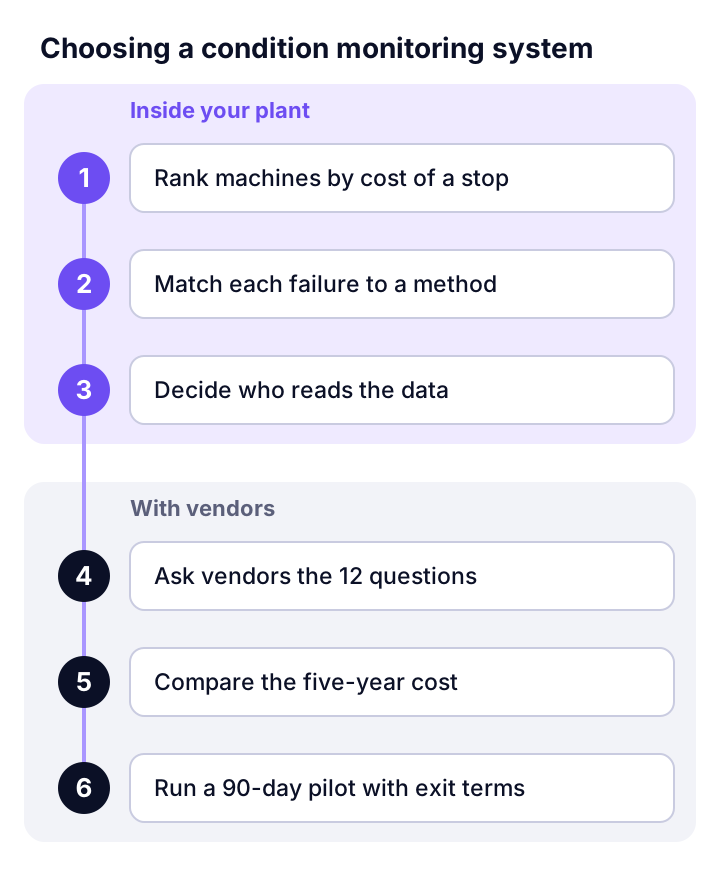
- Rank machines by the cost of a stop. List the machines whose failure stops a line, a kiln or a furnace. Put a rupee figure on one stop for each. Our downtime cost guide shows the six lines that go into it.
- Match each failure to a method. Write down how each machine has failed in the last three years. The table in the next section helps.
- Decide who reads the data. Your own engineer, the vendor's remote analysts, or both. This decides half of the cost.
- Ask the 12 questions below and get the answers in writing.
- Compare five-year cost on the same sheet for every quote.
- Run a 90-day pilot with a written success test and a way out.
Skip step 1 and you end up with sensors on every motor above 30 kW. Most of those motors have a standby or never fail. The money goes where the risk is not.
12 questions to ask before you buy a condition monitoring system
Ask the same 12 questions to every vendor, in the same order. Fill the answers into one sheet so you compare like with like.
Fit to your machines
1. Which of my machines would you monitor first, and why? A good vendor asks for your breakdown register before quoting. A weak one quotes a sensor count straight away.
2. Which failures will it catch on those machines? Each method sees some faults and misses others. Use this table to check the claim against your own failure list.
| Failure you have seen | Method that sees it early | What to ask |
|---|---|---|
| Bearing wear | Vibration (acceleration and envelope) | Does the sensor read high frequencies on this bearing? |
| Misalignment, imbalance, looseness | Vibration (velocity, mm/s RMS) | Are readings placed in ISO 10816 or ISO 20816 zones? |
| Lubrication loss | Vibration plus temperature | How fast does the alert come after grease runs out? |
| Broken rotor bars, supply faults | Motor current | Is current read from the drive or the MCC, or from a new clamp? |
| Gear wear on slow drives (kiln, ball mill) | Low-frequency vibration, oil analysis | What is the sensor's lowest usable frequency? |
Slow machines catch out many systems. A kiln girth gear or a ball mill pinion turns slowly, so its fault frequencies are low. Ask for the sensor's lowest usable frequency in writing. Our guide to industrial IoT sensors covers sensor specs in more detail.
3. Will the hardware last on my floor? Ask for the IP rating and the rated temperature. Then compare them with your worst spot, not an average. Measure the hottest bearing housing on your list with a temperature gun in May. Think about cement and coal dust, monsoon humidity and hose-down areas.
4. Wired, wireless, or data from my PLC? Wireless sensors fit quickly but read every few minutes or hours to save battery. Ask how long the battery lasts at the reading interval you need, not the longest interval. Some machines already have speed, current and temperature in a PLC or SCADA. A system that reads those can save sensors. Our post on SCADA, PLC and IoT gateways explains the layers.
Data, alerts and people
5. Who reads the data and decides what to do? Software flags a change. A person decides if it is a bearing to change on Sunday or a sensor that came loose. ISO 18436-2 sets four levels of vibration analyst, and Category II is the usual level for diagnosis. Ask who reviews your alerts, how many plants each analyst covers, and how fast they reply.
6. How are alarm levels set? Fixed limits from the ISO 10816 vibration zones are a start. A good system also alarms on change from each machine's own normal level. Ask how many false alarms a similar plant saw in its first month, and how they were cut.
7. What happens when the network drops? Many plants have one 4G link or a Wi-Fi network that fails near the furnace. Ask how many hours of readings the gateway keeps, and whether they are sent in order once the link is back.
8. Where does the alert go at 2 a.m.? An email to the reliability engineer is not enough on a three-shift plant. Ask if alerts can go by SMS or WhatsApp to the shift in charge. Then ask how an alert becomes a job in your CMMS or ERP. Our guide to linking condition monitoring with the ERP shows the hand-offs.
Money and terms
9. What is the five-year cost? Get every line: sensors, gateways, fitting, software, analyst service, batteries and your own staff time. The next section works one example.
10. Who owns the data, and can I take it with me? Ask whether you get raw readings and waveforms, or only a health score. Ask for an export in CSV or through an API, during the contract and at the end.
11. Who comes to site, and how fast? Ask where the nearest service engineer sits, whether spare sensors are kept in India, and whether training is in Hindi or the local language for technicians. Ask for the quote in rupees with GST shown.
12. What are the pilot terms? Agree the machines, the length, the success test and the exit before anything is fitted. Our post on why predictive maintenance pilots fail lists the four usual mistakes.
What does a condition monitoring system cost over five years?
The five-year cost is often close between two quotes that look very different on day one. In the illustrative example below, two made-up quotes for 20 machines and 30 sensors differ by ₹8.7 lakh at purchase. After five years they are only ₹30,000 apart.
The figures are made up to show the method. They are not prices from any vendor. Put in the numbers from your own quotes.
| Cost line (illustrative) | Quote A: wireless, cloud, analyst included | Quote B: wired, on-site software, own analyst |
|---|---|---|
| Sensors (30) | ₹5.40 lakh (₹18,000 each) | ₹3.60 lakh (₹12,000 each) |
| Gateways, cabling, panels | ₹1.20 lakh | ₹4.50 lakh |
| Fitting and setup | ₹0.80 lakh | Included above |
| Software | ₹21.60 lakh (₹1,200 per sensor a month, 5 years) | ₹8.00 lakh licence + ₹7.20 lakh support (₹1.44 lakh a year) |
| Batteries (one change in year 4) | ₹0.75 lakh (₹2,500 each) | None |
| Your own staff time | ₹4.50 lakh (10% of a ₹9 lakh engineer, 5 years) | ₹11.25 lakh (25% of a ₹9 lakh engineer, 5 years) |
| Day-one cost | ₹7.40 lakh | ₹16.10 lakh |
| Five-year cost | ₹34.25 lakh | ₹34.55 lakh |
| Per machine per month | about ₹2,850 | about ₹2,880 |
Three things come out of this sum.
- Staff time is a real line. Quote B looks cheaper on software, but someone in your plant must read the data. Leave staff time out of both and B looks ₹6.45 lakh cheaper. Put it in and B costs ₹30,000 more.
- Subscription adds up. Quote A's software line is the biggest single cost. Ask what the price is in year 2 and whether it can rise.
- When costs are close, choose on questions 5 to 8. Alert quality and who acts on it matter more than ₹30,000 over five years.
Now put it against your stops. Our downtime guide works one illustrative 8-hour bar mill stop at ₹23.82 lakh. Avoid one stop like that a year and either quote pays for itself many times over. Avoid none and both are waste. Use the downtime cost calculator with your own line figures.
A scorecard to compare condition monitoring vendors
Score each vendor from 1 to 5 on each line, multiply by the weight, and add up. A total out of 500 makes the gap between vendors easy to see in a review meeting.
| What you score | Weight | Linked questions |
|---|---|---|
| Catches the failures on your critical machines | 20 | 1, 2 |
| Who reads the data, and alert quality | 20 | 5, 6 |
| Five-year cost | 15 | 9 |
| Alerts reach the shift and become jobs | 10 | 8 |
| Keeps working when the network drops | 10 | 7 |
| Hardware survives your heat, dust and water | 10 | 3, 4 |
| Service and spares in India | 10 | 11 |
| Data ownership and exit | 5 | 10, 12 |
Change the weights to fit your plant. A cement plant with dust and heat may weight hardware higher. A plant with no reliability engineer should weight "who reads the data" higher still. Fix the weights before the demos, so a good demo does not change them.
Where choosing a condition monitoring system goes wrong
Most bad choices come from buying the demo, not the system. These are the patterns to watch for.
- Choosing on sensor price. Sensors are often a small part of the five-year cost. Software and people are the big lines.
- No owner for alerts. If nobody is named to act on an alert within a shift, the system becomes a dashboard nobody opens.
- Monitoring everything at once. Two hundred sensors in month one bring two hundred baselines to learn and a flood of alerts. Start with the machines from step 1.
- No baseline before the pilot. Without last year's breakdown hours on the pilot machines, you cannot show the pilot worked.
- Health scores only. If you can't see the readings behind a score, you can't check it or move to another vendor later.
Condition monitoring is also not the answer for every machine. A small pump with a standby and a two-hour swap may be cheaper to run to failure. Say so in your plan, and spend the money on the machines that stop the plant.
Where Vexron fits
Vexron is our predictive maintenance software, so weigh this section as a vendor's view. It reads the PLC, SCADA and sensor data a plant already has, over Modbus, Siemens S7, OPC-UA or EtherNet/IP, so you add vibration sensors only where a machine needs one. The edge gateway places readings in ISO 10816 and ISO 20816 zones and keeps 100,000+ readings when the network drops. Alerts can go by SMS or WhatsApp, and the dashboard shows the cost of stops in rupees. Put it through the same 12 questions as everyone else. For the vibration side on its own, see our online vibration monitoring system page, and for the bigger picture, the predictive maintenance and industrial IoT guide.
Frequently asked questions
What should I look for in a condition monitoring system?
Look for four things. It must measure the failures your critical machines really have. Someone trained must read the data and turn it into a job. Alerts must reach the night shift and keep working when the network drops. And the five-year cost, not the first quote, must make sense against the cost of the stops it should prevent.
Is wireless or wired vibration monitoring better?
Neither is better everywhere. Wireless sensors are quick to fit and suit pumps, fans and motors that change slowly. Wired sensors suit fast-changing or high-risk machines such as turbines, high-speed compressors and big fans where you want continuous data. Many plants use wired on a few critical machines and wireless on the rest.
How many machines should a condition monitoring pilot cover?
Cover enough machines to see real faults in about 90 days, usually 10 to 30 machines that stop production when they fail. Pick machines with a history of bearing, alignment or imbalance problems. Agree the success test and the exit terms in writing before the sensors go on.
Do I need a certified vibration analyst?
Someone must read the alerts and decide what to do. That can be your own engineer or the vendor's remote team. ISO 18436-2 sets four levels of vibration analyst. Category II is the usual level for someone who diagnoses common faults. Ask the vendor who reviews your alerts and what level they hold.
Price the stops first
Work out what one stop on your most critical machine costs. That number tells you how much a condition monitoring system is worth to you.