



The main centrifugal pump failure causes are running far from the best efficiency point (BEP), cavitation, air in the suction, dry running, misalignment and poor bearing lubrication. Most centrifugal pumps should run between 70% and 120% of BEP flow. Outside that range, shaft loads rise and the seal and bearings fail first.
That is why the same pump eats a seal every few months. The fitter changes the seal, the pump runs, and three months later it leaks again. The seal was never the problem. This guide is for the plant or maintenance head with a pump that keeps failing. It covers the eight usual causes, why running off the curve matters so much, why Indian plants see some causes more often, and how to find the cause before you buy the next seal.
Centrifugal pump failure causes: the eight usual reasons
Eight causes explain almost every early failure of a centrifugal pump. Most can be checked in one shift with two pressure gauges, a clamp meter and a torch.
| Cause | What you see on the floor | Fix |
|---|---|---|
| Too little flow (far left of BEP) | Discharge valve half shut, noisy pipes, seal every few months | Trim the impeller, fit a smaller pump or a speed drive, add a minimum flow line |
| Too much flow (far right of BEP) | High motor current, crackling noise, pump "running out" on an open line | Restore system head, check the curve, check if a parallel pump tripped |
| Cavitation from low suction pressure | Gravel sound, pitted impeller eye, flow drops | Raise the sump level, clean the strainer, shorten or enlarge the suction pipe |
| Air in the suction | Flow surges, pump loses prime, vortex at the sump | More submergence, seal suction flanges and glands, fix the bell mouth |
| Seal running dry or flush blocked | Leak soon after start, burnt or cracked seal faces | Prime before start, clear the flush line, add a dry run trip |
| Misalignment and pipe strain | Coupling wear, seal and drive end bearing fail together | Align after the pipes are bolted up, support the pipes on their own |
| Bearing lubrication | Hot bearing housing, rumble, milky oil | Right grease amount and interval, correct oil level, keep water out |
| Wear from dirty or corrosive liquid | Flow and head fall over months, worn wear rings | Right material, check wear ring gap at each overhaul |
The US Department of Energy and the Hydraulic Institute wrote a free pumping system sourcebook that lists the same problems. It names cavitation, internal recirculation, seal or packing wear, poor material choice and wrong shaft loading as the main centrifugal pump problems. It also notes that seal and bearing makers give an expected life. If your parts last much less, find the cause.
Why running away from the best efficiency point kills seals and bearings
A pump is designed for one flow, its best efficiency point. The DOE sourcebook says that at BEP the pump's radial bearing loads are lowest. Move far from it in either direction and the pump starts to wear itself out.
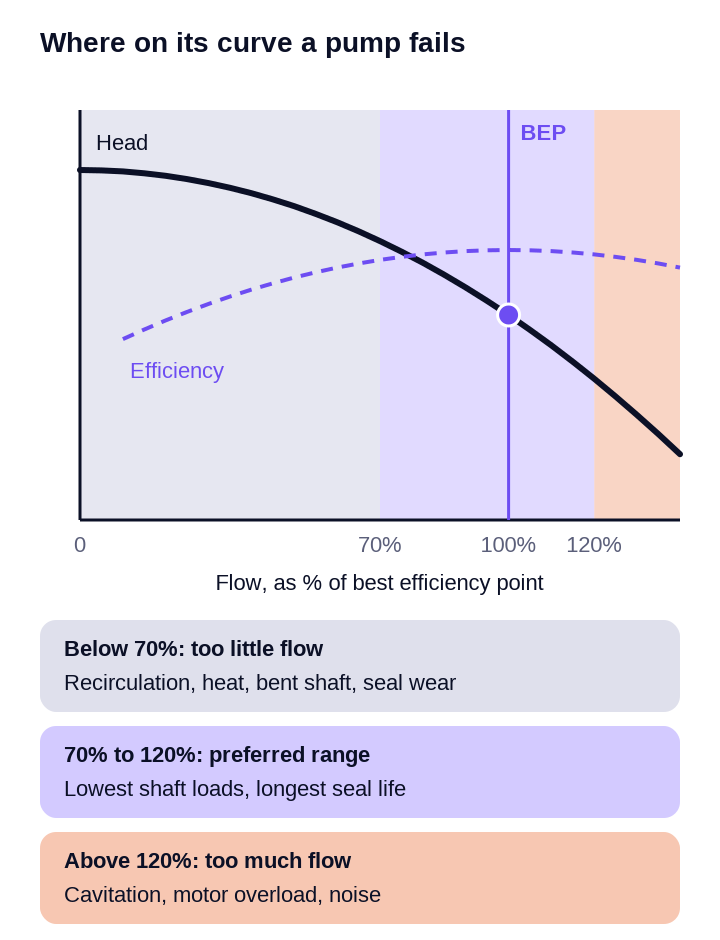
- Too little flow (left side). The liquid no longer matches the impeller vanes. It swirls back at the inlet and outlet (internal recirculation), which damages the impeller like cavitation does. Side load on the impeller grows, so the shaft bends a little at the seal on every turn. At very low flow the liquid heats up. The DOE notes that makers list a minimum flow for this reason.
- Too much flow (right side). The pump needs more suction pressure than it gets, so it cavitates. The motor draws more current and may trip or overheat.
- In the preferred range. In his 2016 WaterWorld article, pump engineer Allan Budris puts the preferred range for most centrifugal pumps at 70% to 120% of BEP. He adds that bearing life normally falls as flow moves away from BEP. High specific speed pumps have a narrower range, so check your maker's curve.
The oversized pump problem
Many plant pumps run left of BEP because they were bought one size up. The DOE sourcebook says engineers add a safety margin and room for future growth, and lists five signs of an oversized pump:
- Loud flow noise in the pipes that everyone has stopped noticing.
- A flow control valve that is mostly closed.
- Heavy use of a bypass line back to the tank.
- Frequent replacement of bearings and seals.
- A pump that keeps starting and stopping.
If your problem pump shows two or more of these, start here, not with the seal.
How to find where your pump runs: a worked check
You need a suction gauge, a discharge gauge and the maker's curve. The numbers below are illustrative. Take a cooling water pump rated for 100 m³/h at 32 m head, with 40 m head at zero flow.
- Read the gauges. Discharge shows 3.9 bar and suction shows 0.3 bar. The difference is 3.6 bar.
- Convert to head. For water, 1 bar is about 10.2 m. So 3.6 bar is about 36.7 m. (This assumes both gauges sit at about the same height.)
- Read the curve. On this pump's curve, 36.7 m of head comes at about 64 m³/h.
- Compare with BEP. 64 ÷ 100 = 64% of BEP. That is below the 70% line.
This pump lives in the grey zone. Its seal and bearings will keep failing until the flow, the impeller or the pump changes. If you have a flow meter, use it as a cross check. Motor current also helps: a pump far left of BEP usually draws much less than its rated current.
Why pumps fail faster in Indian plants
Oversizing, seasonal sump levels, hot water, power trips and local repairs make some causes more common in many Indian plants. None of these is rare, and each one points to a cheap check.
- Bought for the expansion that has not come. The pump was sized for a future second line. Today the valve stays two-thirds shut and the pump runs at half its BEP flow.
- Silt in the monsoon, low sump in May. River and borewell water carries silt in the rains, which wears wear rings and seal faces. In summer the sump level falls, a vortex forms, and air or cavitation follows.
- Hot liquid. Cooling tower return water is hotter in May, and condensate is close to boiling. Hot liquid needs more suction pressure. The DOE lists higher than design temperature and lower than design suction pressure as causes of cavitation.
- Grid trips and DG changeovers. Every trip is a stop and a restart, often with the seal briefly dry. The DOE notes that frequent starting and stopping shortens the time between repairs.
- The gland gets tightened to stop the drip. Packed glands need a slow drip to stay cool. A gland nut tightened until it is dry burns the packing and scores the shaft sleeve.
- The standby pump never runs. It sits for months. Seal faces stick, and bearings get marked by vibration from the running pump next to it. Then it fails on the day it is needed. Swap duty and standby every week or two.
- Local rebuilds without checks. An impeller trimmed by eye, not balanced, with wear ring gaps never measured, comes back with a new set of problems.
Thermal and captive power plants run many pumps of this kind in boiler feed, condensate and cooling water service. Our power plant industry page lists the other machines that can stop a unit.
Mechanical seal failure causes: read the old seal before you fit a new one
The failed seal tells you the cause if you look at it. Keep it, clean it gently and check the faces and the rubber parts before it goes in the scrap bin.
| What you see on the old seal | What it usually means | Where to look next |
|---|---|---|
| Fine heat cracks or burnt marks on the face | Ran dry | Start procedure, priming, sump level, low flow |
| Chipped edges on the hard face | Vibration or cavitation | Operating point, suction, bearings |
| Wear track wider on one side | Shaft moving or not square | Alignment, pipe strain, bearings, bent shaft |
| Crystals or deposits around the faces | Flush blocked or liquid drying out | Flush line, flush plan, liquid temperature |
| Swollen, hard or cracked O-rings | Wrong rubber for the liquid or heat | Material choice with the seal maker |
| Faces look fine, spring or drive broken | Installation error or corrosion | Fitting method, set length, material |
Write the finding on the work order in plain words, such as "dry run marks" or "wear track off centre". After three failures you will see a pattern. If the bearing at the drive end failed at the same time, think alignment and pipe strain. If the motor also ran hot, our guide to motor bearing failure causes covers the motor side.
What a pump failure costs: a worked rupee example
The figures below are illustrative, not a customer result. Take a 45 kW cooling water pump at a rolling mill, with one duty and one standby pump. It is oversized and throttled, and it runs at about 60% of BEP.
| Line | One year as it is | One year after the fix |
|---|---|---|
| Seal changes | 4 × ₹45,000 = ₹1,80,000 | 1 × ₹45,000 = ₹45,000 |
| Bearing changes | 2 × ₹25,000 = ₹50,000 | ₹0 |
| Mill stop when both pumps were down | 8 hours × ₹50,000 per hour = ₹4,00,000 | ₹0 |
| One-time fix: impeller trim by the maker, alignment, site check | ₹0 | ₹1,20,000 |
| Total | ₹6,30,000 | ₹1,65,000 |
The gap is about ₹4.6 lakh in one year, and most of it is the one day both pumps were down. That is the hidden risk of a pump that fails often: sooner or later it fails while the standby is in the workshop. Lower power use after the trim is a further saving, left out here to keep the sum simple. Our guide to calculating the cost of unplanned downtime shows which lines to count. The downtime cost calculator does the sum with your own numbers.
How to find the cause before you change the seal again
Find the operating point first, then the suction, then the mechanics. This order catches the expensive causes before you spend on parts.
- Get the curve. Note the pump model, impeller diameter and speed from the nameplate. Ask the maker for the curve if it is not on file.
- Measure the duty. Read suction and discharge pressure, flow if a meter exists, and motor current. Place the point on the curve as in the worked check above.
- Check the suction. Sump level, strainer, foot valve, suction pipe size and length, liquid temperature. Listen for cavitation.
- Check alignment with the pipes bolted up. Fit a dial gauge on the coupling and loosen the suction and discharge flange bolts. If the shaft moves, the pipes are pulling the pump.
- Take vibration readings. Measure at both bearings in three directions. Compare the overall level with the ISO 10816 vibration zones, or use the free vibration threshold lookup.
- Look at the vane pass frequency. It is the number of impeller vanes times the speed in revolutions per second. A 6-vane impeller at 1,480 rpm gives about 148 Hz. A high peak there often means the pump runs far from BEP or the impeller is too close to the casing tongue.
- Read the failed parts. Use the seal table above and keep the old bearing for a look.
- Record the cause on the work order. Then track the time between failures. A fix that works shows up as a longer gap.
Our vibration analysis basics explain what the sensor measures. The same check order works for the drive end, and our list of gearbox failure causes covers pumps driven through a gearbox.
For most pumps, a monthly vibration route and a pressure reading on each round are enough. For a boiler feed pump, a cooling water pump that stops a mill, or any pump with no standby, continuous monitoring pays back sooner. The predictive maintenance and industrial IoT guide shows how to pick the first machines.
Where Vexron fits
Vexron's VMI-1 model watches fans, pumps and motors from their vibration, temperature and current data. It finds bearing wear, misalignment, imbalance and looseness. Each alert points to the frequency band that triggered it, so your engineer can check it. It will not tell you the pump is oversized. You still need the gauges and the curve for that.
Where this goes wrong
Pump failure analysis has limits. Know them before you trust a conclusion.
- Gauges lie. An old gauge with a stuck needle, or one fitted after a bend, can move your point on the curve by a long way. Check gauges before you trust the sum.
- The curve is for a new pump. Worn wear rings drop the curve. A pump that has run for years delivers less than its curve says.
- Two causes often work together. Low flow bends the shaft, the seal leaks, water gets into the bearing, and the bearing fails. Fix the low flow, not just the bearing.
- Not every pump deserves this. A small transfer pump with a spare on the shelf may be cheaper to run until it fails. Spend the effort where a stop costs lakhs.
- Monitoring does not fix the cause. A sensor tells you the pump is going. Only the checks above stop the next failure.
Frequently asked questions
What is the most common cause of centrifugal pump failure?
Running the pump far from its best efficiency point is behind many repeat failures. Away from that point, the forces on the impeller grow, the shaft bends a little, and the seal and bearings wear out first. Cavitation, air in the suction, dry running and misalignment are the other usual causes. The seal or bearing that broke is usually the result, not the cause.
Why does my pump mechanical seal keep failing?
A seal that fails again and again is usually reporting a problem somewhere else. Check, in order: whether the pump runs dry at start, whether the flush line is blocked, whether the pump runs at very low flow with the valve nearly shut, alignment and pipe strain, and bearing condition. Then look at the old seal faces. Heat cracks mean dry running, chipped edges mean vibration, and an uneven wear track means the shaft is moving.
How do I know if my pump is cavitating?
Listen near the suction. Cavitation sounds like gravel or marbles passing through the pump. Flow and discharge pressure also drop or swing. When you open the pump, the impeller vanes near the inlet eye look pitted, like a sponge. Check the sump level, the suction strainer and the liquid temperature first, since low suction pressure and hot liquid are the usual reasons.
Can a centrifugal pump run with the discharge valve closed?
Only for a very short time, such as a few seconds at start for some pumps. With no flow, all the motor power turns into heat inside the casing. The liquid can boil, the seal runs dry and the shaft takes high side loads. The maker's manual gives a minimum flow. If the process needs low flow, fit a minimum flow line back to the tank, a smaller pump or a speed drive.
Put a rupee figure on your worst pump
Price one unplanned stop on the pump you worry about most. That number tells you how much a site check, an impeller trim or monitoring is worth.