



The main gearbox failure causes are poor or dirty oil, heat, water and dust getting in, bearing wear, misalignment, and shock loads above the rating. In a US Department of Energy summary of NREL's gearbox database, bearings caused 76% of failures and gears 17%. Teeth usually fail last.
That order matters. When a gearbox on a conveyor, kiln drive or mill stops, the broken teeth get the blame. But a broken tooth is most often the end of a chain that started with a bearing, the oil or the coupling. This guide is for the plant or maintenance head whose gearboxes keep failing. It covers the eight usual causes, how to read the damage, why Indian plants see more of some causes, and what a failure really costs.
Gearbox failure causes: the eight usual reasons
Eight causes explain almost every early industrial gearbox failure. Most of them are cheap to check and fix before they become a gearbox change.
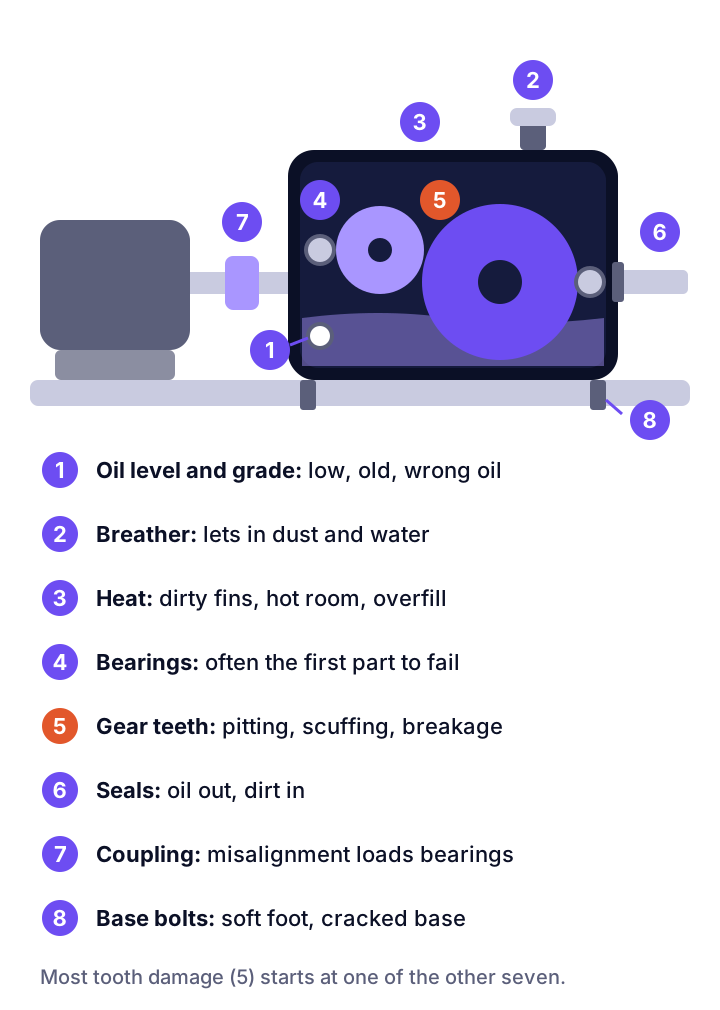
| Cause | What you see on the floor | Fix |
|---|---|---|
| Low, old or wrong oil | Dark oil, low sight glass, rising temperature | Oil grade and level from the maker's plate, a written top-up record |
| Too much heat | Housing too hot to touch, oil smells burnt | Clean fins and fan, check the cooler, correct overfill |
| Dust and dirt in the oil | Gritty oil, worn breather, scored teeth | Filter breather, clean top-up cans, sealed covers |
| Water in the oil | Milky oil, rust on the cover, failures after monsoon | Desiccant breather, seal check, drain water from the sump |
| Bearing wear | Rumble, heat at one bearing housing, shaft play | Vibration checks, change the bearing before it seizes |
| Misalignment and soft foot | Coupling wear, high axial vibration, one bearing hot | Dial or laser alignment, shim the feet, check base bolts |
| Overload and shock load | Broken teeth, motor tripping, failures after jams | Torque limiter or fluid coupling, soft start, fix the jam cause |
| Wrong size or bad rebuild | Failure soon after capacity rise or a repair | Check service factor, backlash and bearing fits after rebuild |
The same DOE summary is about wind turbine gearboxes, from 750 damage records between 2009 and 2015. Plant gearboxes run at steadier loads, so the shares will differ. But the lesson holds: watch the bearings and the oil, and the teeth usually look after themselves.
What the gear teeth tell you about the cause
Each type of tooth damage points back to a cause. Look at the teeth before the gearbox goes to the repair shop, and take photos. ISO 10825-1:2022 is the standard that names these damage types, so use its terms on the work order.
| Damage on the teeth | What it looks like | Usual cause |
|---|---|---|
| Micropitting | Grey, matte, frosted patches | Oil film too thin: wrong grade, oil too hot |
| Pitting (macropitting) | Small craters, often near the pitch line | Load too high for the gear, or load on one edge from misalignment |
| Scuffing | Torn, dragged lines along the tooth height | Oil film broke under heat and load |
| Abrasive wear | Even loss of metal, sharp tooth tips | Dirt in the oil |
| Tooth breakage | Missing tooth or a crack at the root | Shock load, or fatigue after long pitting |
| Contact at one end only | Shiny band on one end of the face | Misalignment, a bent shaft or a worn bearing |
Two quick checks help a lot. First, look at the contact pattern. Even contact across the face is good. Contact at one end means the shafts are not parallel. Second, check every tooth, not just the broken one. If many teeth are pitted, the problem built up over months. If one tooth broke and the rest look clean, look for a shock load or a foreign object.
Why gearboxes fail faster in Indian plants
Heat, dust, monsoon water and stop-start loads are harder on gearboxes in many Indian plants. Each one speeds up the causes above.
- Hot rooms age the oil. Noria's Machinery Lubrication explains the Arrhenius rule: oil life roughly halves for every 10°C rise. Their example is a gearbox at 69°C whose oil lasts two years. At 79°C it needs a change every year. A gearbox in a closed bay near a kiln or furnace can run much hotter in May than in January.
- Dust gets in through the breather. Most gearboxes breathe through a small cap. In cement, coal, sponge iron and mining areas, every warm to cool cycle pulls fine dust inside. A filter or desiccant breather costs little next to a gear set.
- The monsoon puts water in the oil. Rain, wash down and humid air condense inside the casing. Water in oil causes rust and weakens the oil film. Check the sump drain after the first heavy rains.
- Top-up from any drum. The oil can sits open on the floor. A different grade goes in because it was nearby. Mark each gearbox with its oil grade and keep sealed, labelled cans.
- Conveyor jams and direct starts. A jammed belt or a crusher choke sends a torque spike straight into the gear teeth. So does a full-load direct-on-line start. Many repeat tooth failures in coal and limestone handling start here.
- Capacity went up, the gearbox did not. A plant raises output by 15% with a bigger motor or a faster belt. The gearbox stays the same. It now runs above its service factor every day.
If you run a cement plant, our predictive maintenance guide for cement plants ranks kiln drives and mill gearboxes by hours of production lost. The cement industry page lists the other machines whose stop is a kiln stop.
Gearbox overheating causes: what to check first
Most gearbox overheating comes from the oil level, dirty cooling surfaces or a load change. Check these in order, starting with the cheapest:
- Oil level, with the gearbox stopped. Too little oil starves the gears. Too much oil churns and heats up. Both are common.
- Oil grade. Compare the drum label with the maker's plate. A thinner oil runs hotter at the teeth.
- Cooling fins and shaft fan. Dust caked on the fins works like a blanket. Clean them.
- Oil cooler, if fitted. Check water flow and temperature on both sides. Scale in a water cooler cuts its effect.
- Room temperature. Note it next to the gearbox reading. A hot bay may need a guard against radiant heat or better air flow.
- Load. Compare motor current with its normal value. A rise often means a dragging conveyor, a choked mill or a raised output target.
- One hot bearing housing. If one end is hotter than the rest, suspect that bearing or misalignment, not the oil.
Write the temperature down every shift, with the room temperature beside it. A gearbox that runs 10°C hotter than its own normal at the same load has changed, even if it is still below the maker's limit.
What a gearbox failure costs: a worked rupee example
The figures below are illustrative, not a customer result. Take a 90 kW helical gearbox on a limestone conveyor that feeds a raw mill. An intermediate shaft bearing wore out over several weeks. Nobody noticed. It seized, the shaft moved, and two pinion teeth broke.
| Line | Run to failure | Caught early |
|---|---|---|
| Lost output | 36 hours at ₹40,000 contribution per hour = ₹14,40,000 | Bearing changed in a planned 8-hour stop = ₹0 |
| Parts | Bearings, pinion, gear, seals = ₹4,50,000 | Bearings and seals = ₹60,000 |
| Crane, transport, overtime | ₹60,000 | ₹20,000 |
| Total | ₹19,50,000 | ₹80,000 |
The gap is about ₹18.7 lakh for one event. The run to failure case is long because there was no spare gear set in stores. If your plant keeps a spare gearbox, the stop is shorter, but you are paying to hold that spare all year. Our guide to calculating the cost of unplanned downtime shows which lines to count. The downtime cost calculator does the sum with your own numbers.
How to catch a gearbox failure early
Vibration and oil tests catch most gearbox faults weeks before failure. Temperature and noise warn much later. Use the cheap checks on every gearbox and the stronger ones where a stop costs real money.
| Check | What it catches | How often |
|---|---|---|
| Oil level, leaks, breather | Low oil, seal failure, blocked breather | Every shift, on the round |
| Temperature (with room temperature) | Heat from oil, load or one bearing | Every shift |
| Oil test (wear metals, water, particle count, viscosity) | Gear and bearing wear, dirt, water, old oil | Every three to six months, more often when a trend starts |
| Vibration spectrum | Bearing defects, gear mesh problems, misalignment, looseness | Monthly route, or online for critical drives |
| Tooth inspection through the cover | Pitting, scuffing, contact pattern | At each planned shutdown |
On a vibration spectrum, look at gear mesh frequency. It is the number of teeth times the shaft speed in revolutions per second. A pinion with 20 teeth at 1,480 rpm meshes at about 493 Hz. Rising peaks around that frequency, with side peaks spaced at shaft speed, point to tooth wear or a bent shaft. Our vibration analysis basics explain what sensors measure, and the ISO 10816 vibration zones give the overall limits. The motor side of the drive has its own list of motor bearing failure causes.
For a few gearboxes, a monthly route with a handheld analyser and quarterly oil tests is enough. For a kiln drive, a mill gearbox or the one conveyor that stops dispatch, continuous monitoring pays back sooner. The predictive maintenance and industrial IoT guide shows how to choose the first machines.
Where Vexron fits
Vexron's VMI-1 model learns how each machine normally runs from its vibration, temperature and power data. It is used on gearboxes and drivetrains to catch gear mesh and bearing defects before they cause secondary damage. Each alert points to the frequency band that triggered it, so your engineer can check it. Our online vibration monitoring page covers the sensor side.
Where this goes wrong
Gearbox failure analysis has limits. Know them before you trust a conclusion.
- A run to failure hides the first cause. Once teeth break, the bearing and oil evidence is often gone. The earlier you catch it, the clearer the cause.
- Two causes often work together. Misalignment loads a bearing. The bearing heats the oil. The thin oil then pits the teeth. Fix all three, not just the last.
- A new gearbox in the same place fails the same way. If the coupling, the base, the breather or the load did not change, expect the same result.
- Oil tests need a clean sample. A sample from the drain plug full of sludge gives a false alarm. Take it from the same point, while warm, every time.
- Not every gearbox deserves this. A small gearbox with a spare on the shelf, on a job that can wait, may be cheaper to run until it fails. Spend the effort where a stop costs lakhs.
- Monitoring does not fix the cause. A sensor tells you the gearbox is going. Only the checks above stop the next one.
Frequently asked questions
What is the most common cause of gearbox failure?
Bearings are the part that fails most often, and poor oil is the most common reason they fail. In a US wind turbine gearbox database run by NREL, bearings caused 76% of gearbox failures and gears 17%. Plant gearboxes run at steadier loads, but the chain is often the same: a bearing wears, the shaft moves, and the teeth then fail.
Why does my gearbox get hot?
The usual reasons are too much oil, too little oil, the wrong grade, blocked cooling fins or fan, a hot room, or a load above the gearbox rating. Check the oil level with the gearbox stopped, clean the fins, and compare the motor current with its normal value. A gearbox that suddenly runs hotter than its own normal is telling you something changed.
How often should gearbox oil be changed?
Follow the gearbox maker's manual for the oil grade and change interval. Shorten it if the gearbox runs hot, sits in dust or takes in water. A better way is to test the oil every three to six months and change it when the test says so. Hot oil ages fast: its life roughly halves for every 10°C rise.
Can a damaged gearbox be repaired or should it be replaced?
It depends on what failed. A bearing or seal caught early is a simple repair. Pitting on a few teeth can often be watched while you plan a stop. Broken teeth, a cracked casing or a gear set worn by running on a failed bearing usually means a rebuild or a new unit. Find the cause first, or the new gearbox fails the same way.
Put a rupee figure on your worst gearbox
Price one unplanned stop on the gearbox you worry about most. That number tells you how much oil tests, alignment or monitoring are worth.